

AMSOIL 10W-40 100% SYNTHETIC ATV/UTV MOTOR OIL
Product codes and package options
| Product Code | Package Size | Unit of Measure |
|---|---|---|
| AUV40QT-EA | Quart Bottle | Each |
| AUV40QT-CA | Quart Bottle | Case of 12 |
If your machine calls for a 10W-40, odds are good it turns up on this list. AMSOIL 10W-40 100% Synthetic ATV/UTV Motor Oil covers ATVs and UTVs built by Can-Am, CFMOTO, Honda, John Deere, Kawasaki, Kubota, Suzuki, and Yamaha that require 10W-40, and it carries API SL and JASO MA for wet-clutch powertrains where the clutch, transmission, and engine share one oil supply. Friction-durability properties keep clutch slippage, fade, and chatter down under load, and a stay-in-grade formulation holds viscosity through hauling, plowing, and long days on rough trail. Published test data covers viscosity, volatility, wear, and high-temperature shear.
Make sure your machine wants a 10W-40
The application list runs across Can-Am, CFMOTO, Honda, John Deere, Kawasaki, Kubota, Suzuki, and Yamaha, and every entry carries the same condition: your machine has to require a 10W-40 motor oil. API SL and JASO MA are the matching performance marks, and they describe different things. API SL sets the engine performance category, while JASO MA covers frictional behavior in a shared sump where a wet clutch runs in the same oil as the engine.
A long brand list improves your odds, not your certainty. Utility quads, sport machines, and side-by-sides inside those ranges specify different grades by model and year, and a manufacturer listing 10W-40 for one platform may call for something lighter or heavier on the next. Check the manual for your exact model and year before any oil goes in.
How the oil behaves in a wet clutch
Friction-durability properties help minimize clutch slippage, fade, and chatter, which you feel as consistent engagement on takeoffs and while picking your way around obstacles. In a shared sump the same oil lubricates the engine, feeds the transmission, and sits between the clutch plates, so its frictional behavior decides whether engagement stays predictable as things heat up.
JASO MA is the mark that names that frictional performance. The formulation contains no friction modifiers, the additives that cut friction in a car engine and let a wet clutch slip. The oil also controls heat and helps improve clutch life. Aftermarket oil additives are not recommended for use with AMSOIL Synthetic ATV/UTV Motor Oil, so it goes in as supplied rather than getting supplemented at the fill.
Heat, shear, and staying in grade
The stay-in-grade formulation maintains protection in machines used for hauling, plowing, or working tough terrain. Multigrades can shear down under sustained mechanical stress and start behaving like a thinner oil, and stay-in-grade describes one built to resist that drift. Kinematic viscosity measures 88.3 cSt at 40°C and 14.1 cSt at 100°C under ASTM D445, with a viscosity index of 165 under ASTM D2270.
High-temperature, high-shear viscosity is 4.1 cP at 150°C under ASTM D5481. That test forces oil through a narrow gap at high speed and high heat, which approximates the space between a bearing and its journal, so it points at the film that survives where pressure peaks. Advanced synthetic technology resists oxidation and protects against extreme heat to help prevent sludge and varnish.
ASTM D5800 records Noack volatility at 4.7 percent weight loss, a measure of how much oil evaporates at sustained high temperature. Less evaporation means less oil consumed between top-ups and less thickening of what remains. Flash point is 242°C (468°F) and fire point is 268°C (514°F) under ASTM D92, both properties of the fluid rather than limits on the engine.
Cold starts and wear under load
Synthetic technology keeps the oil fluid in subzero temperatures, which supports startup protection after your machine has sat out overnight. A lot of engine wear happens in the seconds after a cold start, before oil has reached the upper end, so how readily an oil moves when cold matters as much as how it holds up at full heat.
Pour point is -40°C (-40°F) under ASTM D97. Pour point marks the lowest temperature at which the oil still flows under laboratory conditions, which makes it a flow property rather than a safe cranking limit. If you work your machine in deep cold, follow the seasonal viscosity guidance in your owner's manual instead of treating the pour point as a floor.
The ASTM D4172 four-ball wear test at 150°C, 1,800 rpm, and 40 kg for one hour produced a 0.57 mm wear scar. The method presses one rotating ball against three fixed in an oil bath and measures the scar worn into the stationary set, so a smaller scar points to a film that kept metal apart under load. Read alongside the high-shear result, it shows how the oil holds up once heat and pressure have pushed it toward its working limit.
Service timing, mixing, and packaging
Keep service timing on the original equipment manufacturer oil-change recommendation. A synthetic base oil does not authorize a longer interval by itself, and the schedule in your manual stays the reference while the machine is under warranty. Duty matters as much as elapsed time, since plowing and hauling load an engine at low travel speed where an hour meter tells you more than an odometer.
The oil is compatible with other synthetic and conventional motor oils, but adding other oils shortens the life expectancy of AMSOIL motor oils and reduces their performance benefits. Extended drain intervals are not supported where oils have been mixed, so topping up with whatever is open on the shelf carries a cost you will not see at the fill.
AUV40QT-EA identifies the individual quart bottle and AUV40QT-CA the case of twelve quarts. Sump capacity varies widely across the machines on the application list, so check the fill quantity in your manual to see how many quarts the service takes. Recycle used oil and the empty bottle when the job is finished.
Verified specifications
| Property | Value | Test Method |
|---|---|---|
| Kinematic Viscosity @ 100°C, cSt | 14.1 | ASTM D445 |
| Kinematic Viscosity @ 40°C, cSt | 88.3 | ASTM D445 |
| Viscosity Index | 165 | ASTM D2270 |
| Flash Point, °C (°F) | 242 (468) | ASTM D92 |
| Fire Point, °C (°F) | 268 (514) | ASTM D92 |
| Pour Point, °C (°F) | -40 (-40) | ASTM D97 |
| Noack Volatility, % weight loss (g/100g) | 4.7 | ASTM D5800 |
| Four-Ball Wear Test, mm (150°C, 1800 rpm, 40 kg, 1 hr) | 0.57 | ASTM D4172 |
| HT/HS Viscosity @ 150°C, cP (1.0 x 10⁶ s⁻¹) | 4.1 | ASTM D5481 |
Questions about AMSOIL 10W-40 100% SYNTHETIC ATV/UTV MOTOR OIL
No. The manufacturer list marks where 10W-40 shows up as a requirement, not blanket fitment across a brand. Model and year both matter, because a manufacturer specifying 10W-40 on one platform may call for a different grade on another. Your machine has to call for 10W-40 with API SL and JASO MA before this oil is the right choice.
JASO MA is a frictional performance standard for engines sharing one oil supply with a wet clutch and transmission. It signals that the oil will not make the clutch slip the way a friction-modified automotive oil can. This formulation contains no friction modifiers, which supports smooth shifting and positive clutch engagement as the oil warms.
Yes, where your machine requires 10W-40. The stay-in-grade formulation maintains protection in ATVs and UTVs used for hauling, plowing, or working tough terrain, and the synthetic base resists oxidation under extreme heat to help prevent sludge and varnish. Sustained low-speed work builds heat without much airflow, which is the condition shear resistance addresses.
Both carry JASO MA, but the 10W-40 is rated API SL and measures 14.1 cSt at 100°C, while the 10W-30 is rated API SJ at 10.5 cSt. That second figure is thickness at operating temperature, so the 10W-40 keeps a heavier film once hot. The grade your machine requires makes the call, not the bigger number.
Pour point is -40°C (-40°F) under ASTM D97, a laboratory flow property rather than a cold-start rating. It marks where the oil stops flowing under test conditions, not the lowest temperature at which an engine will crank and circulate oil safely. For deep-cold work, follow the seasonal viscosity guidance in your owner's manual.
No. The original equipment manufacturer oil-change recommendation applies, and extended drain intervals are not supported where this oil has been mixed with another. Aftermarket oil additives are not recommended either, so the oil goes in as supplied and comes out on the schedule your manual sets. Dust, deep water, and heavy load can all shorten that schedule.
Related products in this category
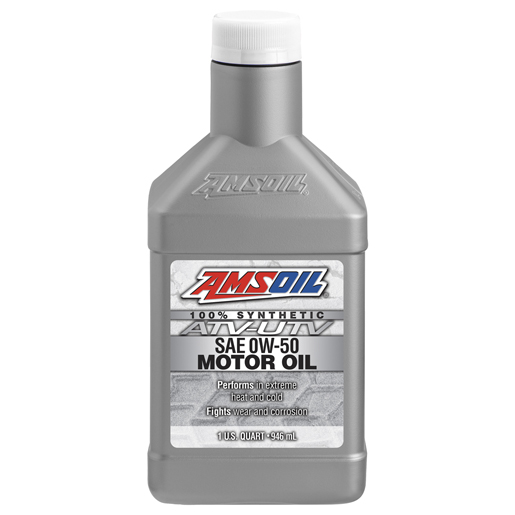
AMSOIL 0W-50 100% SYNTHETIC ATV/UTV MOTOR OIL
0W-50 synthetic that drops into a Polaris Ranger, RZR, Sportsman, or General built around PS-4 Extreme, and stays in through summer.
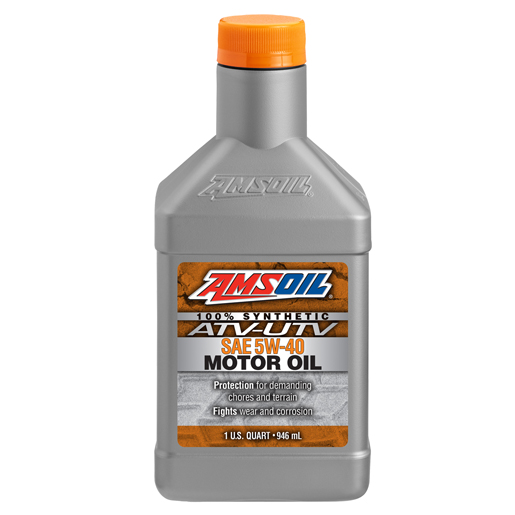
AMSOIL 5W-40 100% SYNTHETIC ATV/UTV MOTOR OIL
Wet-clutch-safe 5W-40 for Can-Am, CFMOTO, and Kawasaki machines that carry accessories and work hard in the heat, with a 0.38 mm wear scar.
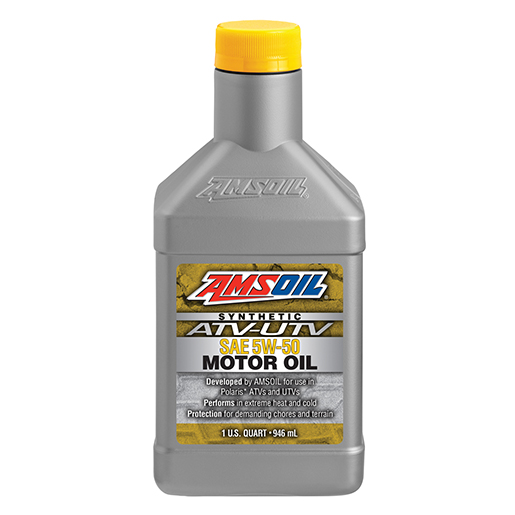
AMSOIL 5W-50 100% SYNTHETIC ATV/UTV MOTOR OIL
The heaviest grade in the ATV/UTV range at 20.1 cSt, built for Polaris machines that call for a 5W-50 with API SL and JASO MA.