

AMSOIL INTERCEPTOR® 100% Synthetic 2-Stroke Oil
Product codes and package options
| Product code | Package or selection |
|---|---|
| AITQT-EA | Quart bottle |
| AITQT-CA | Case of 12 quart bottles |
| AIT1G-EA | Gallon jug |
| AIT1G-CA | Case of 4 gallon jugs |
| AIT16-EA | 16-gallon keg |
| AIT55-EA | 55-gallon drum |
| AIT27-EA | 275-gallon tote |
Check the engine manual for API TC or JASO FD, then match the oil delivery method. AMSOIL INTERCEPTOR® 100% Synthetic 2-Stroke Oil fits direct-fuel-injected, electronic-fuel-injected, and carbureted two-stroke engines in quads, sleds, dirt bikes, and personal watercraft. Pour it into the injection tank where the pump meters oil, or mix it at 50:1, which is 2.6 fl. oz. per U.S. gallon of gasoline. The test file includes a 50-hour Rotax E-TEC 800R dyno program, ASTM bench testing against a benchmark oil, and a rental sled teardown after 1,617 miles in the Canadian Rockies.
Find API TC or JASO FD
Open the engine manual before the bottle opens. The oil category printed there decides the fit, not the machine shape. INTERCEPTOR® is formulated for two-stroke engines calling for API TC or JASO FD, whether the engine sits in a quad, sled, dirt bike, or personal watercraft.
Published equipment families include Polaris, BRP/Ski-Doo with Rotax E-TEC engines, Arctic Cat with C-TEC2 engines, Honda, Yamaha, Kawasaki, and Suzuki, across direct-fuel-injected, electronic-fuel-injected, and carbureted designs. Treat that as a family list, not a model lookup. Your manual still settles the category, delivery hardware, and mix ratio.
Injection tank or 50:1 premix
Use the delivery method the engine was built for. On an oil-injection machine, INTERCEPTOR® goes in the injection tank and the pump meters the dose as load changes. On a premix engine, measure 2.6 fl. oz. per U.S. gallon of gasoline for the 50:1 ratio.
Measure against the fuel you actually pour, not the tank size printed in a brochure. A 50:1 direction does not convert an injection engine to premix, and it does not override a manual that calls for another ratio. Modern leaner mixtures make a sloppy pour harder on bearings, rings, and pistons.
Cold flow in the numbers
Kinematic viscosity is 6.5 cSt at 100°C and 30.7 cSt at 40°C under ASTM D445, with a viscosity index of 172 under ASTM D2270. That index describes how much the oil thins as temperature climbs. A steadier film matters when the pump meters small shots into a hot two-stroke.
Pour point is -63°F (-53°C) under ASTM D97. Read it as a cold-flow figure, not an operating temperature promise. It tells you the oil still moves in a laboratory pour-point test, which matters on a sub-zero start and in an injection line that spent the night cold.
The SAE J1536 fluidity and miscibility grade is 4 Arctic Climate, measured against a 17,000 cP ceiling. That grade covers two behaviors at once: how freely the oil moves when cold, and how readily it blends with gasoline instead of separating out in the tank. Flash point and fire point both measure 102°C (216°F) under ASTM D92, the points at which vapor above the sample ignites briefly and then sustains a flame.
Burn-off, power valves, and teardown proof
A two-stroke burns its oil, so the useful part is what survives long enough to lubricate. High-molecular-weight synthetic components with high flash points resist burn-off, leaving more oil available for pistons, rings, and bearings instead of sending it straight out the pipe.
Deposits are where power valves get lazy. A thermally stable synthetic base plus high-temperature detergency and dispersancy additives fight the carbon and varnish that make a valve stick. Field testing reported complete prevention of exhaust power valve sticking.
A rental sled ran 1,617 miles (2,602 km) in the Canadian Rockies before teardown. The pistons were virtually carbon-free with nearly all factory coating still present, and the power valves stayed clean and moving. Rental mountain miles are hard miles, which is why that bench look matters.
Fifty hours on a dyno and two bench tests
The dynamometer program put a 2012 Ski-Doo Renegade X with a Rotax E-TEC 800R engine through 50 hours of computer-controlled load, roughly a full season of riding compressed. Every run started on a fresh top end of new cylinders, pistons, rings, and wrist pin bearings. Maximum rpm of 7,900 came around again and again, and exhaust gas temperatures often passed 1,200°F.
An ASTM calibrated rater scored the teardown. Merit ratings run 1 to 10, where 10 is a part free of defects and 0 is catastrophic distress. INTERCEPTOR® took perfect 10 ratings for piston ring sticking on both cylinders and recorded zero piston skirt scuffing. Undercrown deposits, which form on the underside of the piston crown, rated 7.76 and 7.90 against 2.66 and 3.48 for the XPS-2 Synthetic 2-Cycle Oil benchmark, wrist pin bearings scored 8.92 on both sides against 8.05 and 8.35, and exhaust ports rated 9.54 with 1 percent blockage.
Two bench tests ran alongside it. The ASTM D 4863 lubricity test runs a small engine at a 150:1 gas-to-oil ratio, far leaner than a Rotax E-TEC meters, then shuts off the cooling fan so heat climbs, pistons expand, and torque falls; a smaller torque reduction points to better lubricity. INTERCEPTOR® recorded 2.83, 3.62, and 4.42 lb.in. at 572, 617, and 662°F against 3.23, 4.00, and 4.79 for the benchmark. The ASTM D 4857 detergency test runs 20 hours at 50:1 and returned perfect 10.0 ratings for piston scuffing on both faces, top ring sticking, and cylinder liner wear, with 9.8 and 9.3 for piston varnish.
Verified specifications
| Service categories | API TC and JASO FD |
|---|---|
| Pour point | -63°F (-53°C) |
| Use method | Injection oil or 50:1 premix when appropriate |
| 50:1 measure | 2.6 fl. oz. per U.S. gallon of gasoline |
Questions about AMSOIL INTERCEPTOR® 100% Synthetic 2-Stroke Oil
Yes, where the engine specifies API TC or JASO FD. Two-stroke ATVs sit in the published range alongside snowmobiles, motorcycles, and personal watercraft. Your engine manual confirms the category and whether the machine takes injection oil or measured premix.
Use 2.6 fl. oz. of INTERCEPTOR® per U.S. gallon of gasoline. Measure against the fuel you actually add, and use that ratio only on engines calling for 50:1. Oil-injection machines take the same product in the injection tank with the pump doing the metering.
Pour point is the lowest temperature at which the oil still flows under ASTM D97 laboratory conditions, so -63°F (-53°C) describes fluidity rather than a rated operating limit. It matters at cold start and in an injection line that has been sitting outside overnight.
In the ASTM D 4863 lubricity test at 150:1, torque reduction measured 2.83, 3.62, and 4.42 lb.in. at 572, 617, and 662°F against 3.23, 4.00, and 4.79 for XPS-2 Synthetic 2-Cycle Oil as the benchmark, and a lower torque loss indicates better lubricity. Both oils prevented piston skirt scuffing in the detergency test.
Compatibility with most conventional and synthetic two-stroke oils is published, so topping off a partly full tank works. Performance is best when mixing is kept to a minimum, which argues for running one oil through a full tank instead of layering brands across several fills. No specific incompatible product is named.
No. The Runs on Freedom® Limited Snowmobile Warranty covers engine repairs for up to two years, 5,000 miles, or 8,000 km on a current-model-year or newer sled running INTERCEPTOR® exclusively. It is a snowmobile program, so an ATV, a motorcycle, or a personal watercraft sits outside it. Top off that sled with another brand and it no longer qualifies either.
Related products in this category
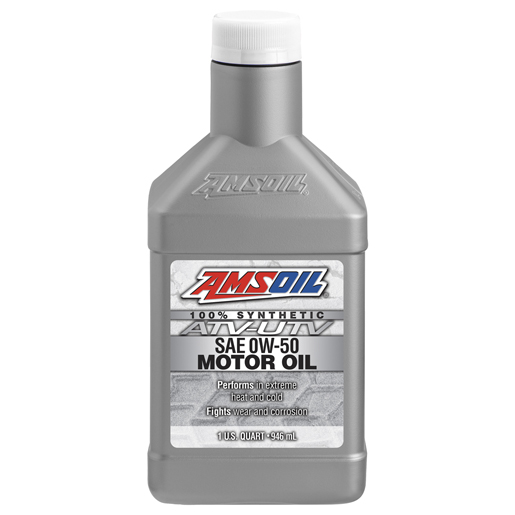
AMSOIL 0W-50 100% SYNTHETIC ATV/UTV MOTOR OIL
0W-50 synthetic that drops into a Polaris Ranger, RZR, Sportsman, or General built around PS-4 Extreme, and stays in through summer.
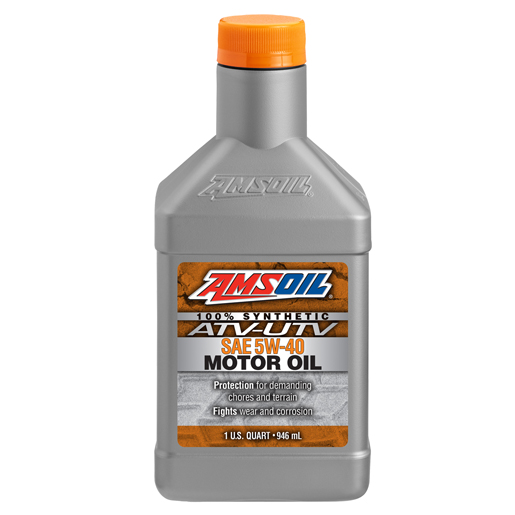
AMSOIL 5W-40 100% SYNTHETIC ATV/UTV MOTOR OIL
Wet-clutch-safe 5W-40 for Can-Am, CFMOTO, and Kawasaki machines that carry accessories and work hard in the heat, with a 0.38 mm wear scar.
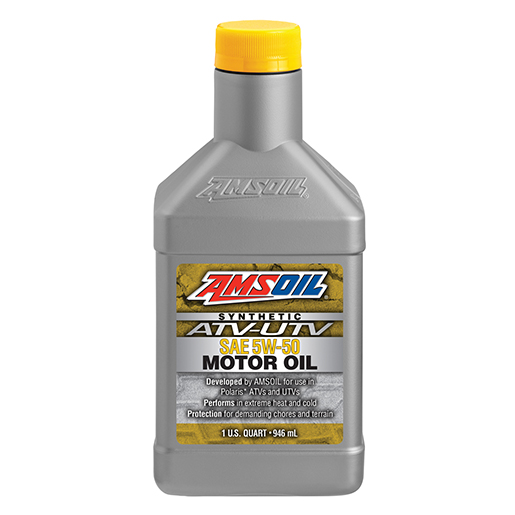
AMSOIL 5W-50 100% SYNTHETIC ATV/UTV MOTOR OIL
The heaviest grade in the ATV/UTV range at 20.1 cSt, built for Polaris machines that call for a 5W-50 with API SL and JASO MA.