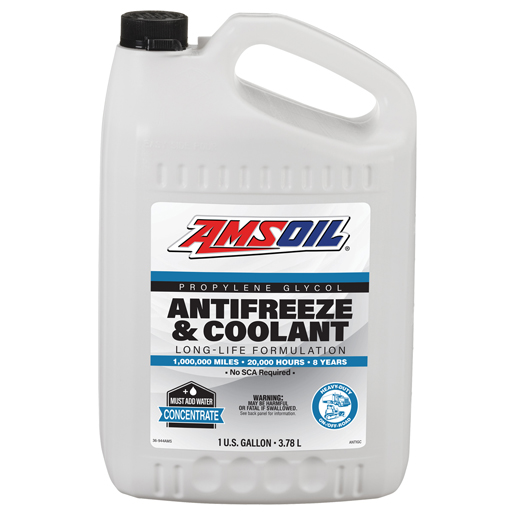
AMSOIL POWERSPORTS ANTIFREEZE & COOLANT
Product codes and package options
| Product Code | Package Size | Unit of Measure |
|---|---|---|
| PSAFQT-EA | Quart Bottle | Each |
| PSAFQT-CA | Quart Bottle | Case of 12 |
Pour this coolant straight from the bottle into a machine that calls for ethylene glycol 50/50 premix. AMSOIL Powersports Antifreeze & Coolant already carries high-purity water, so you do not mix tap water into the system or guess at a ratio beside the bench. It fits on-road and off-road motorcycles, UTVs, ATVs, snowmobiles, outboard motors, and personal watercraft calling for ASTM D3306, ASTM D4985, ASTM D6210, or ASTM D7583. The published protection range is -34°F (-37°C) for freezing, 226°F (108°C) for boil-over, and up to five years of all-season service.
Where this premix belongs
Open the service manual and look for ethylene glycol 50/50 premix. If that wording is there, this quart has a job. The same bottle can serve an ATV, UTV, sled, outboard, personal watercraft, or motorcycle when the manual calls for the same coolant type.
Some manuals name a standard instead of spelling out the chemistry. ASTM D3306, ASTM D4985, ASTM D6210, and ASTM D7583 all line up with this coolant. Find one of those in the maintenance section and you have a cleaner answer than matching bottle color or brand habit.
No mixing at the bench
Leave the measuring cup on the shelf. The high-purity water is already blended into the bottle, and the directions do not call for any more. Tap water brings minerals into the system, and those minerals can plate out as scale right where the coolant needs clean metal to move heat.
The quart bottle fits small cooling systems better than a gallon jug that sits half-used all season. PSAFQT-EA is the single quart and PSAFQT-CA is the case of twelve, so you can buy one top-off bottle or stock the shelf for several machines.
What the temperature numbers mean
Boil-over protection reaches 226°F (108°C), which matters when a side-by-side crawls in low range or a bike sits with little air moving through the radiator. Coolant that flashes to vapor stops carrying heat off the metal, and a vapor pocket is how a hot spot starts.
Freeze protection reaches -34°F (-37°C), and that number does its work while the machine is parked. A coolant that freezes in an unheated shed cannot circulate when the next start comes around. Keep it liquid and the system can move heat the way it was built to.
Do not use the number as a bandage for a sick cooling system. A correct fresh fill that still runs hot points at a clogged radiator, stuck thermostat, weak fan, low level, or another mechanical problem. Fix that before chasing a different label.
Metals, hoses, and cavitation
Powersports systems lean hard on aluminum, so the coolant has to protect that metal instead of merely surviving beside it. This formula is built for the metals common in powersports cooling systems and stays compatible with copper, bronze/brass alloys, and most common hose and gasket materials.
Scale, deposits, and corrosion all steal heat transfer before they kill a part outright. Deposits build on the same surfaces that need clean contact with coolant, and corrosion starts the leaks and rough passages that turn a simple service item into a teardown.
Cavitation works out of sight. Bubbles form where coolant moves through a low-pressure area, collapse against metal, and pit the surface one hit at a time. The formula helps prevent corrosion and inhibits cavitation, which covers damage your temperature gauge will not call out.
Top-offs, service life, and handling
Use it for an emergency top-off over most other coolants if that is what gets the machine home. Mixing still makes the finished concentration unknown, so freeze protection becomes a guess. Flush the system at the next convenient stop and get back to one known 50/50 fill.
Service life runs up to five years for all-season protection against boil-over, freezing, corrosion, and deposits. The extended-life chemistry is free of borate, nitrite, phosphate, and 2EH. Check coolant level at every oil-change interval and let the owner's manual set any shorter model-specific service point.
Let the engine cool before the radiator cap comes off. Treat new and used coolant as hazardous, clean up spills, keep it away from children, and dispose of or recycle the fluid and bottle under local rules.
Questions about AMSOIL POWERSPORTS ANTIFREEZE & COOLANT
No. It is already premixed 50/50 with high-purity water, so pour it at bottle strength. Adding water moves the blend away from the ratio tied to the -34°F and 226°F protection numbers, and tap water can bring minerals into the cooling system.
Yes, if both manuals call for ethylene glycol 50/50 premix. Coverage includes on-road and off-road motorcycles, UTVs, ATVs, snowmobiles, outboard motors, and personal watercraft, along with ASTM D3306, ASTM D4985, ASTM D6210, and ASTM D7583 applications.
In a pinch, yes. It is compatible with most other coolants, but the mixed system no longer has a known 50/50 concentration. Treat that as a get-home top-off, then flush at the next convenient service point so freeze and boil-over protection are predictable again.
Up to five years of all-season protection against boil-over, freezing, corrosion, and deposits. The extended-life chemistry is free of borate, nitrite, phosphate, and 2EH. Check the level at every oil-change interval and follow the owner's manual if the machine calls for shorter service.
Aluminum is the big reason. Powersports cooling systems contain more of it than many other systems, and this formula is optimized around those metals while staying compatible with copper, bronze/brass alloys, and most common hose and gasket materials. It also inhibits cavitation.
This one is an ethylene glycol 50/50 premix that takes no added water, and it is built around powersports cooling-system metals. AMSOIL Propylene Glycol Antifreeze and Engine Coolant is a concentrate blended with low-hardness water for passenger cars, light trucks, and heavy-duty or off-road equipment.