
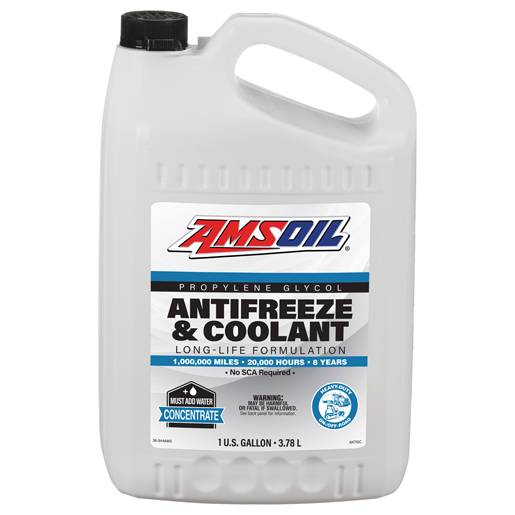
AMSOIL PROPYLENE GLYCOL ANTIFREEZE AND ENGINE COOLANT
Product codes and package options
| Product Code | Package Size | Unit of Measure |
|---|---|---|
| ANT1G-EA | Gallon Jug | Each |
| ANT1G-CA | Gallon Jug | Case of 4 |
| ANT55-EA | 55 Gallon Drum | Each |
Mix this concentrate before it reaches the radiator. AMSOIL Propylene Glycol Antifreeze and Engine Coolant needs distilled water or water under 100 ppm total hardness, then a freeze-point check on the finished blend. The hybrid organic acid formula is published for domestic and import passenger cars, light trucks, heavy-duty applications, off-road equipment, and gasoline or diesel engines calling for ASTM D3306, ASTM D6210, ASTM D4985, or AS 2108-2004 Type A. A 50 percent mix protects to -34°F (-36°C), boils at 222°F (106°C) at sea level, and runs up to 150,000 miles or five years in passenger cars and light trucks.
Match the manual first
Check two lines in the manual before this jug goes on the bench. The machine needs to call for propylene glycol, and it needs one of the listed standards: ASTM D3306, ASTM D6210, ASTM D4985, or AS 2108-2004 Type A. The formula is engineered to exceed original equipment manufacturer and ASTM D3306 requirements.
The heavy-duty list includes Case New Holland, Cummins CES 14603, DDC 93K217, Freightliner 48-22880, GM Heavy Truck, JIS K2234, MAN 324, MB DBL 7700, MTU MTL 5048, Mack 014GS17004, PACCAR CS0185, Scania TB1451, and Volvo Heavy Truck. None of that makes it an ATV or UTV default. Your side-by-side still needs its own manual to call for propylene glycol.
Water quality matters
Use distilled water or water below 100 ppm total hardness from calcium and magnesium compounds. That is a tight limit, and plenty of shop tap water will not meet it. Pour from the hose and those minerals ride straight into the cooling system.
Calcium and magnesium react with conventional inhibitors and form precipitates that stick to metal as scale and corrosion. This formula resists that problem better than conventional chemistry, but the water spec still matters. Check the freezing point after mixing, and never pull the radiator cap while the engine is hot.
Set the concentration on purpose
A concentrate makes you responsible for the protection range. At sea level, boiling point is 219°F (104°C) at 40 percent antifreeze, 222°F (106°C) at 50 percent, and 225°F (107°C) at 60 percent. A 50 percent mixture protects against freezing to -34°F (-36°C).
Pick the mix for the climate and the work, then test it. Freeze protection covers the parked vehicle on a cold night, while boil-over protection covers hot metal under load. If coolant turns solid or flashes to vapor, it is no longer moving heat through the system.
Radiator-cap pressure changes the top number. A 15-psi cap adds 40 to 45°F to the boiling point, putting a 50 percent mixture at 265°F (129°C). That extra margin comes from pressure, so the cap and the concentration both decide the practical boil-over point.
Organic acids, not the old pack
The chemistry is proprietary hybrid organic acid technology, or HOAT. Unique organic acids form a protective layer on metal components, while phosphate, nitrite, silicate, borate, and amine stay out of the formula. That matters in hard-working cooling systems where corrosion protection cannot depend on quick-depleting additives.
Those five conventional inhibitors are tied to most scaling problems in cooling systems. They can react with calcium and magnesium in water, form precipitates, and stick to metal surfaces. They can also drop out at the wrong pH or after an incompatible mix. Leaving them out virtually eliminates scaling problems.
Independent ASTM corrosion and erosion testing returned nearly perfect scores on cast aluminum cylinder heads, steel, copper, solder, brass, and cast iron and aluminum water pumps. A cooling system is a mixed-metal loop, so the test list matters as much as the final score.
Cavitation, mixing, and drain life
Cylinder liners can cavitate when vibration and pressure changes form vapor bubbles beside the wall. Those bubbles collapse and pit the liner. This coolant protects against cavitation erosion and corrosion pitting, with outstanding performance in ASTM D7583, the John Deere Cavitation Test, and it does it without nitrite technology.
Neutral yellow dye identifies the product, not the chemistry. Compatibility covers all ethylene and propylene antifreeze and coolant colors, cooling-system hose and gasket plastics and elastomers, fully formulated diesel antifreezes, and other OAT and HOAT formulations. Still, mixing propylene and ethylene glycol makes freeze protection hard to predict, so flush after an unavoidable top-off.
Drain life runs up to 150,000 miles (240,000 km) or five years in passenger cars and light trucks, and up to 1,000,000 miles (1,600,000 km), 20,000 operating hours, or eight years in heavy-duty applications, whichever comes first. No supplemental coolant additives or extenders are required. ANT1G-EA is the gallon, ANT1G-CA is the case of four, and ANT55-EA is the 55-gallon drum.
Questions about AMSOIL PROPYLENE GLYCOL ANTIFREEZE AND ENGINE COOLANT
Yes. It is a concentrate, so mix it with distilled water or water under 100 ppm total hardness before filling the system. Then check the freezing point of the finished mixture. Pouring it in undiluted skips the step that sets the protection range.
Only if the machine manual calls for propylene glycol and one of the listed standards. Published applications cover passenger cars, light trucks, heavy-duty and off-road equipment, and gasoline and diesel engines, with no ATV or UTV models named. Your manual has to make the match.
A 50 percent mixture protects against freezing to -34°F (-36°C) and boils at 222°F (106°C) at sea level. At 40 percent the boiling point is 219°F (104°C), and at 60 percent it is 225°F (107°C). A 15-psi radiator cap raises a 50 percent mix to 265°F (129°C).
Phosphate, nitrite, silicate, borate, and amine account for almost all scaling in cooling systems. They can react with calcium and magnesium in water, form precipitates, and stick to metal surfaces. Leaving all five out virtually eliminates scaling problems.
Up to 150,000 miles (240,000 km) or five years in passenger cars and light trucks. Heavy-duty applications run up to 1,000,000 miles (1,600,000 km), 20,000 operating hours, or eight years, whichever comes first. Supplemental coolant additives and extenders are not required.
This is a propylene glycol concentrate blended with low-hardness water for passenger cars, light trucks, and heavy-duty or off-road equipment. AMSOIL Powersports Antifreeze & Coolant is a finished 50/50 ethylene glycol premix that takes no added water and is optimized for powersports cooling-system metals.
