
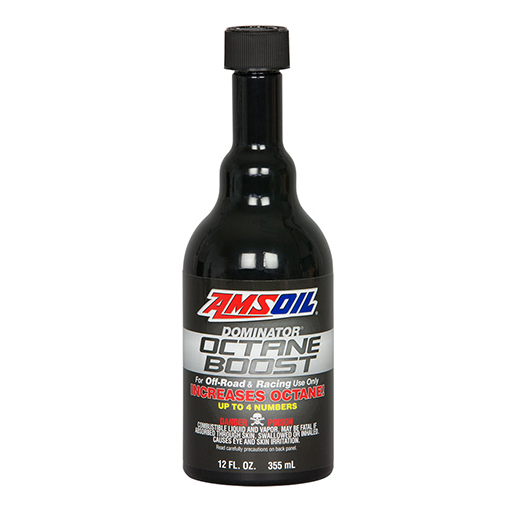
AMSOIL DOMINATOR OCTANE BOOST
Product codes and package options
| Product Code | Package Size | Unit of Measure |
|---|---|---|
| AOBBE-EA | 12 oz. Bottle | Each |
| AOBBE-CA | 12 oz. Bottle | Case of 6 |
When your engine starts pinging under load, you are hearing fuel light itself off before the spark gets there, and that costs you power before it costs you parts. AMSOIL DOMINATOR® Octane Boost lifts octane up to four numbers in two-stroke and four-stroke gasoline engines, which sharpens throttle response and quiets the knock. Read the label first, because this one is off-road and racing use only, so how you ride settles eligibility before engine type ever comes up. Most riders get the ideal result from one 12-ounce (354 mL) bottle per 15 gallons (57 litres) of gasoline, and the same rate applies when it stands in for lead.
Off-road and racing only, whatever you ride
Two-stroke and four-stroke gasoline engines both take the treatment, and high-performance off-road and racing machines are where it belongs. The label draws a hard line at off-road and racing use only, and that line settles most of the selection questions before engine specifics ever matter.
Ride something plated and legal on public roads and you are outside the restriction no matter how well the engine would respond. A dedicated race quad, a sand car, or a track-only bike sits squarely inside it.
What octane actually buys you
Knock is fuel igniting on its own inside the combustion chamber, ahead of the spark, in an uncontrolled explosion instead of a controlled burn. You hear it as pinging or rattling under load, it robs power, and left alone it does serious engine damage.
The octane number rates how well a fuel resists that self-ignition. Lower numbers knock more easily, higher numbers hold out longer, and none of it says anything about how much energy the fuel carries. Get the octane right and the knock goes away, which is the whole job here.
Up to four numbers is a ceiling at the published rate, not a promise for every tank. Read those two words the way they are written and a two-number lift out of marginal pump gas will not catch you off guard.
Measure against the fuel in your tank
One 12-ounce bottle covers 15 gallons of gasoline. Almost nothing in the powersports world holds that much, so dumping the whole bottle into a quad, a dirt bike, or a sled is the wrong move on a race weekend.
Scale it down instead. Five gallons takes a third of the bottle and two and a half gallons takes a sixth. Overshooting the rate buys you nothing and burns through a bottle that should have covered several fills.
What one dose does besides raising octane
Knock control is the headline and the rest comes along with it. Ignition and throttle response sharpen up, power comes back, the fuel burns cleaner, and carbon deposits already sitting in the chamber get cleaned out rather than just held in check.
Those results travel together because they share a root. Knock, lazy response, and combustion chamber crud all trace back to what happens during the ignition event, so an additive aimed at that moment reaches all three at once.
Lead substitute duty and handling the bottle
Collector cars, older off-road equipment, and pleasure vehicles can run it as a lead substitute at the same rate. That job does not loosen the off-road and racing restriction, so a vintage machine faces the same boundary a race quad does. Twelve ounces per 15 gallons stays the number either way.
The red fluid is thin and lighter than water, running 2.36 cSt at 40°C with a relative density of 0.817 to 0.903 at 21.1°C (70°F), so it pours fast through a narrow filler neck. Flash point sits above 60.6°C (141.1°F) by closed cup, which makes it combustible rather than flammable.
Take the hazards seriously. It is harmful if swallowed, fatal if inhaled, may be fatal if it enters your airways, irritates skin, is suspected of causing cancer, and can damage organs with repeated exposure. Keep heat, flames, and sparks away while you pour, never cut or drill the bottle, and grab AOBBE-EA for a single 12 oz. bottle or AOBBE-CA for a case of six.
Questions about AMSOIL DOMINATOR OCTANE BOOST
Up to four numbers at the published rate, which is a ceiling rather than a guarantee for every tank. Octane measures resistance to knock and not energy content, so what you feel is cleaner ignition and no pinging rather than extra power out of the fuel itself.
No. The label limits it to off-road and racing use only, and broad two-stroke and four-stroke compatibility does not stretch that boundary. A machine plated for public roads is out regardless of how the engine would respond. A race quad or a track-only bike is in.
Scale the dose to the fuel in the tank. A full 12-ounce bottle covers 15 gallons, so five gallons takes about a third and two and a half gallons takes a sixth. Emptying the bottle into a small tank gets you nothing extra and wastes several fills worth of product.
Fuel igniting on its own inside the combustion chamber ahead of the spark, in an uncontrolled explosion rather than a controlled burn. You hear pinging under load, you lose power, and unchecked it causes serious engine damage. Enough octane eliminates it.
Yes, in collector cars, older off-road equipment, and pleasure vehicles, at the same 12 ounces per 15 gallons. That role does not relax the off-road and racing restriction printed on the label, so a collector machine faces the same use limit a race quad does.
It is a combustible liquid with a flash point above 60.6°C (141.1°F), so keep heat, flames, and other ignition sources away and stop static sparks while you pour. Heated containers can burst violently, and you should never pressurize, cut, weld, drill, or grind the bottle. Proposition 65 information applies.
Related products in this category
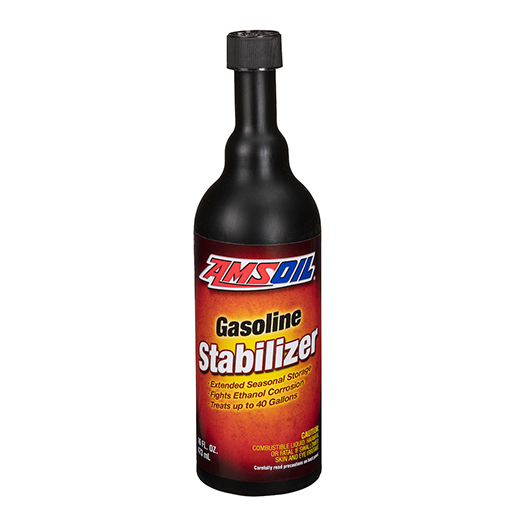
AMSOIL GASOLINE STABILIZER
Long-storage fuel treatment that stops oxidation, blocks varnish and gum, and fights ethanol corrosion so you never have to drain the tank.
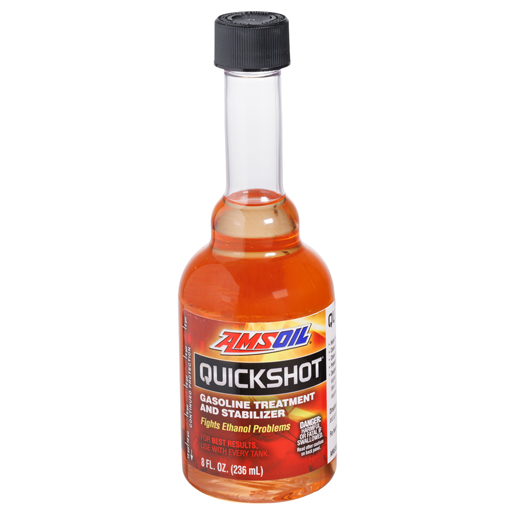
AMSOIL QUICKSHOT GASOLINE TREATMENT AND STABILIZER
Powersports fuel additive that clears carburetor and injector deposits, keeps ethanol water dispersed, and stabilizes gas for short-term storage.