
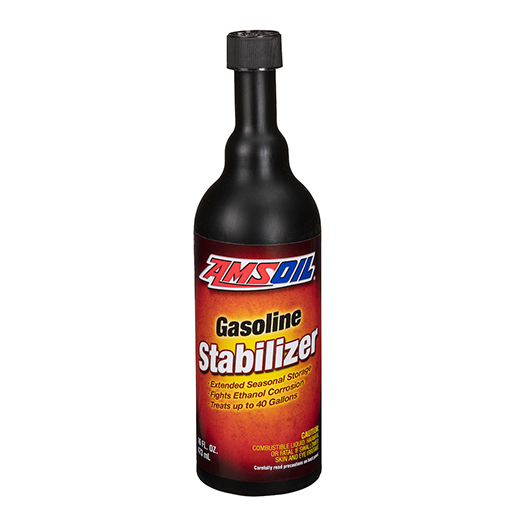
AMSOIL GASOLINE STABILIZER
Product codes and package options
| Product Code | Package Size | Unit of Measure |
|---|---|---|
| ASTCN-EA | 16 oz. Bottle | Each |
| ASTCN-CA | 16 oz. Bottle | Case of 6 |
| AST55-EA | 55 Gallon Drum | Each |
The carburetor you rebuild every spring is usually the fuel's fault, not the machine's. Gasoline is not built to sit and can start going off in as little as 30 days, leaving varnish and gum in the jets and lines. AMSOIL Gasoline Stabilizer shuts down the oxidation behind that and keeps treated fuel from deteriorating for up to 12 months, so you can park a machine full instead of draining it. One ounce handles 2.5 gallons, ethanol blends up to 10 percent included, and a five to 10 minute run pushes the treated fuel through the whole system before the machine goes away.
Gas goes bad faster than you think
Anything you run seasonally has to fire up and run right when you drag it back out, whether that is a sled, a personal watercraft, a snowblower, an outboard, or a classic car. Gasoline works against that, because it is not formulated to sit and can start degrading inside 30 days.
What degraded fuel leaves behind is varnish and sludge that plugs injectors, fuel lines, and carburetors, sticks floats, and turns into hard starting, poor running, more maintenance, and a shorter life for the equipment. A carb sitting full of stale fuel all winter is the classic version, and you pay for it on the bench in spring.
Eight times the oxidation stability in the D525 test
The triple-length ASTM D525 test holds a fuel sample under oxygen pressure at elevated temperature and clocks how long it holds out before oxidizing. Independent third-party testing on fuel with no oxidation-stability additives in it recorded 4,320 minutes treated against 536 minutes for Sea Foam Motor Treatment.
That is an eight-times result, with samples obtained on July 1, 2022, and the comparison product purchased on June 30, 2022. Oxidation is the chemistry behind varnish and gum, so a longer time in that test lines up directly with how easily your machine starts after a layup.
Corrosion protection tested in salt water
Corrosion got its own test, a modified NACE TM0172 run with synthetic sea water per ASTM D665B, again by an independent third party using samples from those same dates. Treated fuel delivered corrosion protection Sea Foam Motor Treatment could not match and kept the metal corrosion free even under salt water.
Salt water is a brutal medium for a fuel additive, and it is a fair one if you live near the coast, launch into brackish water, or winter a machine behind a truck that runs salted roads. Fighting ethanol corrosion is that same property described in everyday terms.
One ounce per 2.5 gallons, then run it
Measure against the gasoline actually in the tank rather than what the tank could hold, so a machine put away half full takes half the dose. One ounce covers 2.5 gallons, ethanol blends up to 10 percent included, which is what most pumps are selling.
Treat the fuel before storage, then let the engine run five to 10 minutes so the additive works all the way through the system. That run carries treated fuel out of the tank and into the lines, the filter, and the carb or injectors, which are the parts that suffer when stale fuel sits in them.
Shut it down afterward and park the machine somewhere dry and covered. The additive handles what happens inside the fuel system and the storage spot handles everything outside it, which is why those two instructions belong together.
Treat it instead of draining it
Draining a tank is a pain and it creates its own problems. Bare metal inside an empty tank starts to corrode, and gaskets and seals that stayed wet with fuel dry out and crack. Treating removes the reason to drain and keeps deposits from forming, which is one less carburetor to clean or replace in spring.
Some pump fuel arrives with oxidation inhibitors already in it and some has none, and nothing at the pump tells you which one you got. That uncertainty is the argument for treating every machine you store rather than gambling on the last tank you bought.
ASTCN-EA is the 16 oz. bottle and ASTCN-CA the case of six, with AST55-EA covering a 55-gallon drum for bulk work. At one ounce per 2.5 gallons a single 16-ounce bottle treats 40 gallons. The amber fluid is combustible with a 62°C flash point, so keep it away from heat, stay out of the mist while pouring, and never fight a fire involving it with a water jet.
Questions about AMSOIL GASOLINE STABILIZER
Up to 12 months, which means the machine starts easily when you pull it back out. Untreated gasoline can begin degrading in as little as 30 days, so the difference between treating and skipping it shows up well before a full season has gone by.
The triple-length oxidation stability test clocks how long fuel resists oxidizing under oxygen pressure at elevated temperature. Independent third-party testing on fuel with no oxidation-stability additives recorded 4,320 minutes treated against 536 minutes for Sea Foam Motor Treatment, an eight-times result.
One ounce per 2.5 gallons of the fuel actually in there, not the tank's rated capacity. Five gallons takes two ounces. A 16-ounce bottle covers 40 gallons at that rate, which is several seasons for one quad or one autumn for a shed full of equipment.
Yes. Let it run five to 10 minutes so the additive circulates through the whole fuel system, then shut it down and store the machine somewhere dry and covered. Skip the run and treated fuel sits in the tank while the lines, filter, and carb hold untreated fuel all winter.
No. Draining is difficult, it leaves bare metal inside the tank to corrode, and it lets gaskets and seals dry out and crack. Treating removes the need to drain before long-term storage and stops the deposits that force a carburetor cleaning or replacement later.
ASTCN-EA is the 16 oz. bottle, ASTCN-CA the case of six, and AST55-EA a 55-gallon drum for bulk treatment. Package size changes nothing about the rate of one ounce per 2.5 gallons or the five to 10 minute run afterward. All two-stroke and four-stroke engines are covered.
Related products in this category
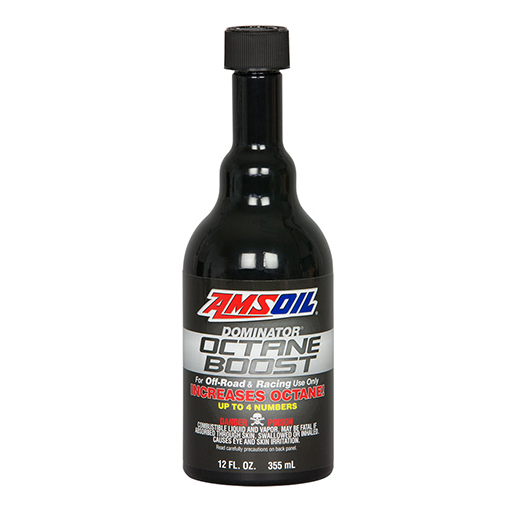
AMSOIL DOMINATOR OCTANE BOOST
Off-road and racing octane additive that kills knock, cleans carbon off the piston tops, and doubles as a lead substitute in older equipment.
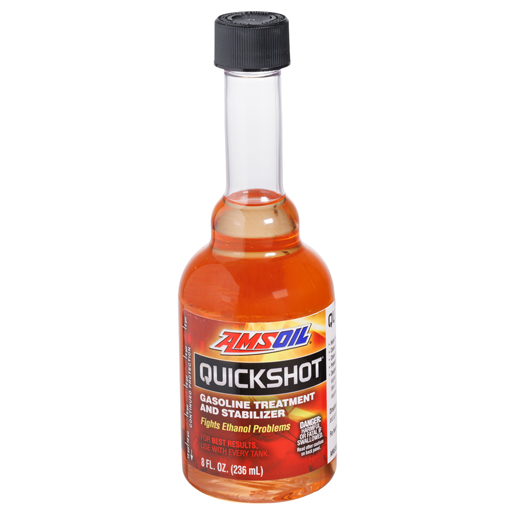
AMSOIL QUICKSHOT GASOLINE TREATMENT AND STABILIZER
Powersports fuel additive that clears carburetor and injector deposits, keeps ethanol water dispersed, and stabilizes gas for short-term storage.