
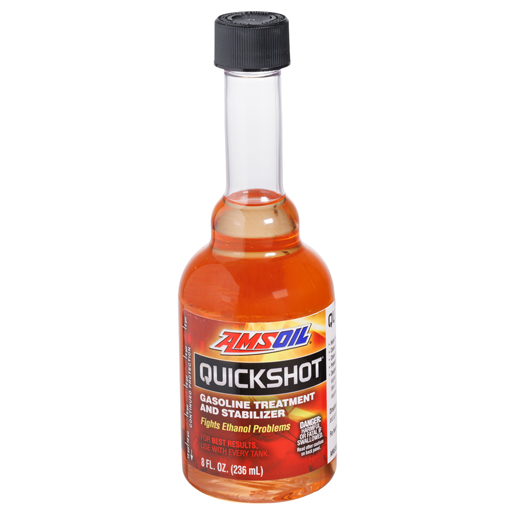
AMSOIL QUICKSHOT GASOLINE TREATMENT AND STABILIZER
Product codes and package options
| Product Code | Package Size | Unit of Measure |
|---|---|---|
| AQSCN-EA | 8 oz. Bottle | Each |
| AQSCN-CA | 8 oz. Bottle | Case of 6 |
| AQSQT-EA | Quart Bottle | Each |
| AQSQT-CA | Quart Bottle | Case of 12 |
Ethanol, water, and whatever the local pump is selling are the three things wrecking small-engine fuel systems, and Quickshot was built for exactly those. AMSOIL Quickshot® Gasoline Treatment and Stabilizer cleans out the fuel system, brings performance back, and stabilizes gasoline through short-term storage in powersports machines and small engines. Testing in fuel with 10 percent ethanol recorded a 70 percent flow improvement through injectors that had been deliberately plugged, and oxidation stability came out 44 percent better than untreated fuel. Run 8 oz. per 6 gallons for the initial cleanup, then 8 oz. per 12 gallons after that.
Where the deposits actually form
Degraded fuel leaves varnish, gum, and insoluble debris that plug carburetors, fuel injectors, and fuel filters. Those three share a weakness: each one meters or filters fuel through a passage measured in fractions of a millimeter, where a deposit you would never notice on a bigger part changes the flow.
Carbon builds separately, forming on the pistons during combustion and bringing pre-ignition, rough idle, and lazy throttle response with it. Quickshot cleans hard-to-remove deposits off piston tops, spark plugs, and other combustion chamber parts, so one treatment covers both the fuel system and the chamber.
Expect this to matter more over time, since ethanol content in pump gasoline keeps climbing. That makes the additive ongoing maintenance for equipment running on whatever the local station sells rather than a repair you go looking for after something quits.
Why the detergent in pump gas is not enough
Every gallon sold in the United States carries a lowest additive concentration of detergent. That is a floor, not a target, and those minimums are not enough to keep deposits off the critical fuel-system parts in the equipment this additive serves.
Quickshot uses chemistry that detaches deposits and carries them away to keep buildup from returning in fuel systems, injectors, and carburetors. Read that as two jobs, because a cleaner that loosens deposits without transporting them just moves your problem downstream to the filter.
Ethanol, water, and phase separation
Ethanol absorbs water and separates out of the gasoline, which is phase separation. That mixture sinks to the bottom of the tank, degrades down there, and creates gum, varnish, and insoluble debris that plug fuel passages and hurt how the engine runs.
The bigger problem is when that layer gets pulled into the engine. An ethanol and water mixture creates a lean-burn condition that drives combustion chamber temperatures up and can lead to engine damage, which is a faster and far more expensive failure than a plugged jet.
Quickshot keeps water from ethanol dispersed in tiny molecules throughout the tank and moves it out as a normal part of running the engine, which cuts the chance of separation. Keeping water spread out is what heads off both the sludge at the bottom of the tank and the lean-burn event above it.
Two treat rates, with room to be approximate
The initial clean-up dose is 8 oz. (236 ml) per 6 gallons (23 litres) of gasoline. After that, continued protection runs 8 oz. per 12 gallons (45 litres), which is half the concentration, and you can add it with every tank for the best protection.
Both numbers go against the gasoline actually in your tank rather than its rated capacity, so a three-gallon quad tank takes half a cleanup dose. Slight over-treatment does no harm, which gives you margin when you are eyeballing the fuel level at the pump instead of measuring it.
Where it fits, and how to handle the bottle
Quickshot suits all two-stroke and four-stroke gasoline engines, from motorcycles, sleds, boats, personal watercraft, and quads through edgers, tillers, mowers, snowblowers, chainsaws, generators, and farm and construction equipment. For larger engines and passenger vehicles, reach for AMSOIL P.i. Performance Improver instead, and for a full seasonal layup AMSOIL Gasoline Stabilizer carries the up-to-12-month figure.
The orange liquid smells of aromatic hydrocarbon, flashes at 94°C (201.2°F) by closed cup, runs 1.88 cSt at 40°C, and is insoluble in water, which fits an additive that stays in the fuel rather than joining any water in the tank. It causes serious eye and skin irritation and may be fatal if swallowed and it enters your airways.
Wear gloves and eye protection while you pour, wash your hands afterward, and store the bottle locked up instead of on an open bench. AQSCN-EA is the 8 oz. bottle and AQSCN-CA the case of six, while AQSQT-EA is the quart and AQSQT-CA the case of twelve. That 8-ounce bottle matches the rates exactly, covering 6 gallons for cleanup or 12 for maintenance in one pour.
Questions about AMSOIL QUICKSHOT GASOLINE TREATMENT AND STABILIZER
It clears varnish, gum, and insoluble debris out of carburetors, injectors, and filters, reaches hard-to-remove deposits on piston tops, spark plugs, and other combustion chamber parts, keeps ethanol water dispersed, and stabilizes fuel through short-term storage. Less pre-ignition, smoother idle, and better throttle response follow from that.
Quickshot was tested in fuel containing 10 percent ethanol. Injectors that had been deliberately plugged showed a 70 percent flow improvement, and oxidation stability came out 44 percent better than untreated fuel. The first number is recovered flow through fouled injectors, the second is resistance to the reaction that makes gum and varnish.
Eight ounces per 6 gallons for the initial cleanup, then 8 ounces per 12 gallons after that. Both go against the fuel actually in the tank rather than its rated capacity, so a three-gallon quad tank takes half a cleanup dose. Add it with every tank for the best protection.
Slight over-treatment causes no problems, which gives you room when you are estimating the fuel level rather than measuring it. That tolerance is not a reason to empty a bottle into a two-gallon tank, but a pour that lands a little over the rate is nothing you need to fix.
Ethanol absorbs water and separates from the gasoline, sinking to the bottom of the tank where it degrades and makes gum, varnish, and insoluble debris that plug fuel passages. Pulled into the engine, that mixture creates a lean-burn condition that raises combustion chamber temperatures and can lead to engine damage.
Quickshot stabilizes fuel through short-term storage, while AMSOIL Gasoline Stabilizer carries the up-to-12-month figure for a full seasonal layup. For larger engines and passenger vehicles, reach for AMSOIL P.i. Performance Improver instead, which keeps Quickshot in small-engine and powersports duty across shorter downtime.
Related products in this category
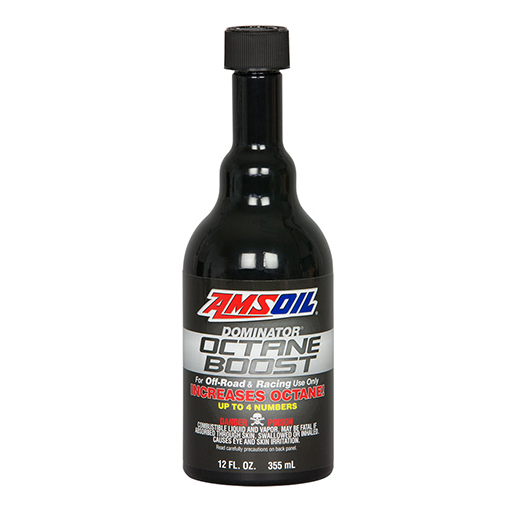
AMSOIL DOMINATOR OCTANE BOOST
Off-road and racing octane additive that kills knock, cleans carbon off the piston tops, and doubles as a lead substitute in older equipment.
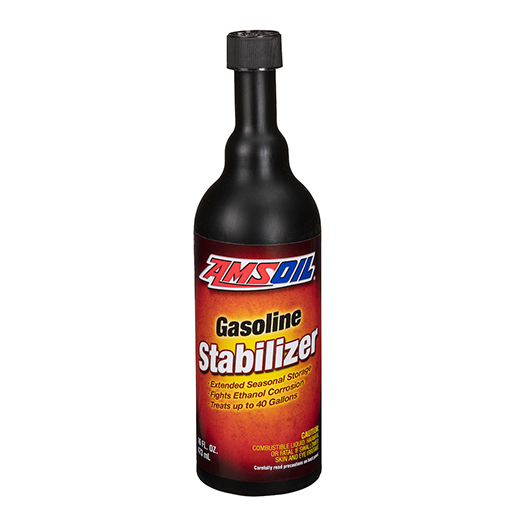
AMSOIL GASOLINE STABILIZER
Long-storage fuel treatment that stops oxidation, blocks varnish and gum, and fights ethanol corrosion so you never have to drain the tank.