
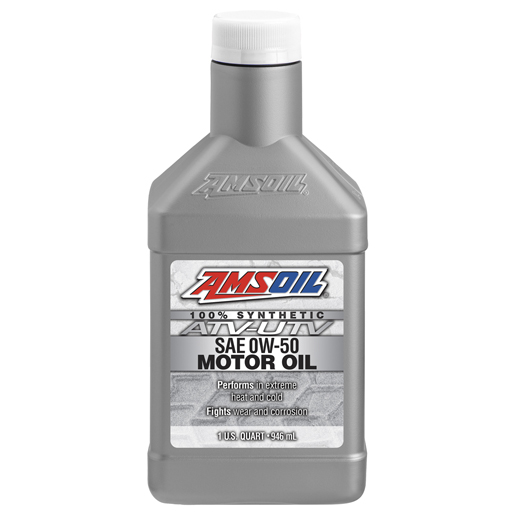
AMSOIL 0W-50 100% SYNTHETIC ATV/UTV MOTOR OIL
Product codes and package options
| Product Code | Package Size | Unit of Measure |
|---|---|---|
| AUV05QT-EA | Quart Bottle | Each |
| AUV05QT-CA | Bottle | Case of 12 |
Grab this one when your Polaris Ranger, RZR, Sportsman, or General calls for a 0W-50. AMSOIL 0W-50 100% Synthetic ATV/UTV Motor Oil is recommended in place of Polaris PS-4 Extreme Full Synthetic 0W-50 Engine Oil, so it goes into the same sump the factory fluid came out of. It pours at -48°C (-54°F), holds a viscosity index of 191, and stays in service through summer in applications that otherwise want you switching to a 10W-50 once the heat arrives. Read the grade in your manual first, then match the quantity to your machine.
Polaris machines that call for 0W-50
Use it in ATVs and UTVs that require a 0W-50 motor oil, which is where the Polaris Ranger, RZR, Sportsman, and General show up. Those four names cover a lot of engines and a lot of model years, so a badge on the fender settles nothing on its own. Open the manual for your exact model and year and read the grade before you order.
The replacement recommendation is specific. This oil goes in place of Polaris PS-4 Extreme Full Synthetic 0W-50 Engine Oil as a cost-effective alternative to the factory branded bottle. It does not make 0W-50 a stand-in for the 5W-50 or any other grade in the range. Warranty Secure coverage keeps your factory warranty intact where the grade matches.
What a viscosity index of 191 buys you
Kinematic viscosity runs 114.4 cSt at 40°C and 19.4 cSt at 100°C under ASTM D445. Feed those two readings into ASTM D2270 and you get a viscosity index of 191, which is shorthand for how little the oil thins as it heats. The flatter that curve, the closer cold oil behaves to oil already up to temperature.
That 191 is the highest of the five grades in the AMSOIL Synthetic ATV/UTV Motor Oil range, ahead of 179 for the 5W-50, 177 for the 5W-40, 165 for the 10W-40, and 148 for the 10W-30. Pairing a 0W winter rating with a 50-weight hot grade is what it takes to get there. Use the number to compare oils, not to talk yourself out of the grade your engine wants.
Cold mornings and the -48°C pour point
Pour point is -48°C (-54°F) under ASTM D97. That test chills a sample in steps and records the last temperature where it still moves, so treat it as a laboratory flow property rather than a cranking limit for your machine. What it does tell you is that the oil stays fluid well into subzero territory and keeps startup protection available.
Cold matters because oil drains back to the sump every time the machine sits. The first few revolutions after a cold start run on the thinnest film of the whole service cycle, so how fast oil climbs to the top end is a wear question rather than a convenience. For deep cold, go by the seasonal guidance in your owner's manual.
Heat, shear, and what the bench tests measured
High-temperature, high-shear viscosity is 5.0 cP at 150°C under ASTM D5481. The test squeezes oil through a tight clearance at speed and heat, which is about as close as a laboratory gets to a spinning journal in its bearing. It describes the film that survives where pressure peaks rather than the bulk viscosity of a still sample.
In the ASTM D4172 four-ball wear test at 150°C, 1,800 rpm, and 40 kg for one hour, the scar came out at 0.53 mm. One ball spins against three clamped in an oil bath, and the flat worn onto the fixed set gets measured afterward. Smaller scars point to a film that held the loaded surfaces apart, though the figure ranks lubricants against each other rather than predicting engine hours.
Noack volatility is 6.7 percent weight loss under ASTM D5800, the highest of the five grades here, which follows from how wide a 0W-50 spread has to be. Flash point is 220°C (428°F) and fire point 230°C (446°F) under ASTM D92. Both are open-cup ignition properties of the fluid, not temperatures your engine is meant to reach.
Year-round fills, mixing, and two bottle codes
Leave it in through summer. All-season performance makes this grade a year-round fill in applications that otherwise recommend a switch to 10W-50 once temperatures climb, which takes one drain and refill off the calendar. Resistance to thinning from extreme heat and mechanical shear is what keeps a hot sump from drifting below the film the engine expects.
Skip the aftermarket additives. The package is balanced as supplied, and anything poured in at the fill changes proportions that were set on purpose. A top-up from another bottle does no immediate harm, since the oil is compatible with synthetic and conventional motor oils, but a mixed sump gives up service life, performance benefit, and any support for an extended drain.
AUV05QT-EA is the single quart bottle and AUV05QT-CA is the case of twelve. Sump capacity swings across the Polaris machines on the list, so pull the fill quantity out of your manual before you decide how many quarts to order. Keep service timing on the original equipment manufacturer oil-change recommendation, recycle the used oil and the empty bottle, and keep the product away from children.
Verified specifications
| Property | Value | Test Method |
|---|---|---|
| Kinematic Viscosity @ 100°C, cSt | 19.4 | ASTM D445 |
| Kinematic Viscosity @ 40°C, cSt | 114.4 | ASTM D445 |
| Viscosity Index | 191 | ASTM D2270 |
| Flash Point, °C (°F) | 220 (428) | ASTM D92 |
| Fire Point, °C (°F) | 230 (446) | ASTM D92 |
| Pour Point, °C (°F) | -48 (-54) | ASTM D97 |
| Noack Volatility, % weight loss | 6.7 | ASTM D5800 |
| Four-Ball Wear Test, mm (150°C, 1800 rpm, 40 kg, 1 hr) | 0.53 | ASTM D4172 |
| HT/HS Viscosity @ 150°C, cP | 5.0 | ASTM D5481 |
Questions about AMSOIL 0W-50 100% SYNTHETIC ATV/UTV MOTOR OIL
Only if your Ranger calls for a 0W-50. The listed applications are ATVs and UTVs that require a 0W-50 motor oil, including the Polaris Ranger, RZR, Sportsman, and General. Grade requirements move around by model and model year inside every one of those families, so check the manual for your exact machine.
Yes. It is recommended in place of Polaris PS-4 Extreme Full Synthetic 0W-50 Engine Oil as a cost-effective alternative to the factory branded fluid, and Warranty Secure coverage keeps your factory warranty intact. Your machine still has to specify 0W-50 for that swap to apply.
It tells you how little the oil thins between 40°C and 100°C, calculated from ASTM D445 readings of 114.4 cSt and 19.4 cSt. At 191 it is the flattest of the five grades in this range. A flat curve narrows the gap between cold-start behavior and fully warm behavior, but it does not change which grade your engine needs.
Not in applications where 0W-50 is listed as a year-round option. All-season performance covers both ends of the calendar in machines that otherwise recommend a hot-weather switch to 10W-50, and the formulation resists thinning from extreme heat and mechanical shear. Your manual still sets which grades are acceptable in each season.
The ASTM D97 pour point is -48°C (-54°F), which is the lowest temperature a chilled sample still moved in the laboratory rather than a rated starting floor. The oil stays fluid in subzero conditions and gives you cold flow for quick starts. For deep cold, follow the seasonal guidance printed in your owner's manual.
Topping up works, because the oil is compatible with synthetic and conventional motor oils, but a mixed sump loses life expectancy and performance benefit, and extended drain intervals are not supported afterward. Aftermarket oil additives are not recommended for use with AMSOIL Synthetic ATV/UTV Motor Oil. After mixing, keep service timing on the original equipment manufacturer oil-change recommendation.
Related products in this category
AMSOIL 5W-40 100% SYNTHETIC ATV/UTV MOTOR OIL
Wet-clutch-safe 5W-40 for Can-Am, CFMOTO, and Kawasaki machines that carry accessories and work hard in the heat, with a 0.38 mm wear scar.
AMSOIL 5W-50 100% SYNTHETIC ATV/UTV MOTOR OIL
The heaviest grade in the ATV/UTV range at 20.1 cSt, built for Polaris machines that call for a 5W-50 with API SL and JASO MA.
AMSOIL 10W-30 100% SYNTHETIC ATV/UTV MOTOR OIL
Purpose-built 10W-30 for Honda quads and side-by-sides, carrying API SJ, JASO MA wet-clutch performance, and the lowest evaporation loss in the range.