
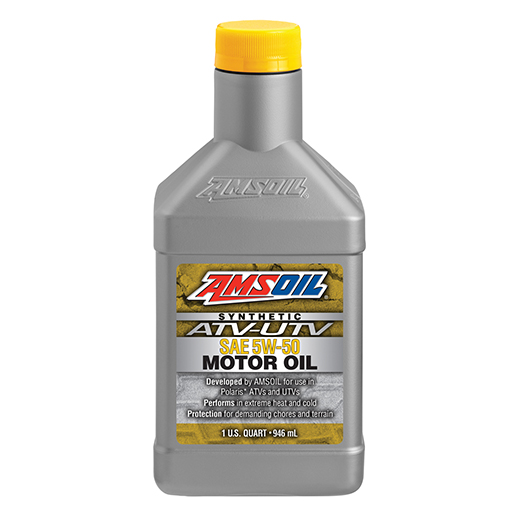
AMSOIL 5W-50 100% SYNTHETIC ATV/UTV MOTOR OIL
Product codes and package options
| Product Code | Package Size | Unit of Measure |
|---|---|---|
| AUV50QT-EA | Quart Bottle | Each |
| AUV50QT-CA | Quart Bottle | Case of 12 |
| AUV5055-EA | 55 Gallon Drum | Each |
Reach for this one when your Polaris Ranger, RZR, Sportsman, or General wants a 5W-50 with API SL and JASO MA behind it. AMSOIL 5W-50 100% Synthetic ATV/UTV Motor Oil is recommended in place of Polaris PS-4 Full Synthetic 5W-50 Engine Oil, and it is the heaviest grade in the AMSOIL Synthetic ATV/UTV Motor Oil range at 20.1 cSt at 100°C with 5.3 cP of high-shear viscosity. A Polaris Ranger XD 1500 ran 2,000 miles of severe-duty dyno work on it, and the teardown backs up the wear numbers. Warranty Secure coverage keeps your factory warranty intact.
Polaris families that list 5W-50
Use it in ATVs and UTVs that require a 5W-50 motor oil, which is where the Polaris Ranger, RZR, Sportsman, and General turn up. Family names mark where the grade shows up, not which machines take it. A Ranger built one year and a Ranger built the next can call for different grades, so let the requirement in your owner's manual pick the fill.
The swap is specific. This oil is recommended in place of Polaris PS-4 Full Synthetic 5W-50 Engine Oil and gives you a cost-effective alternative to the factory branded fluid, with Warranty Secure coverage keeping your factory warranty intact. None of that makes 5W-50 interchangeable with a lighter or heavier grade.
What the Ranger XD 1500 teardown found
Dyno testing put a Polaris Ranger XD 1500 through 2,000 miles of severe-duty operation, matching the Polaris engine drain interval instead of stretching past it. The teardown afterward found virtually no wear in the cylinders. Bore condition carries weight in a result like that, because a worn cylinder loses the ring seal that holds compression and keeps combustion gases out of the crankcase.
The pistons came out with no scuffing on the skirts and little to no staining on the under crown. Skirt scuffing is what a failed oil film leaves behind when the piston touches the bore wall, and under-crown staining points to oil cooking against the hottest surface it touches. Both observations come from one instrumented program rather than field service, and neither sets a drain interval for your machine.
The heaviest film in the range
Kinematic viscosity is 128.2 cSt at 40°C and 20.1 cSt at 100°C under ASTM D445, with a viscosity index of 179 under ASTM D2270. Both viscosity readings top the AMSOIL Synthetic ATV/UTV Motor Oil range, which runs down to 65.7 cSt and 10.5 cSt for the 10W-30. A heavier hot grade puts more film between loaded surfaces once the engine is up to temperature.
High-temperature, high-shear viscosity is 5.3 cP at 150°C under ASTM D5481, again the highest of the five grades. The test drives oil through a narrow gap at high speed and high heat, standing in for a bearing under load rather than a sample sitting still. Thicker is not automatically better, since a grade heavier than your engine expects costs pumping energy and slows circulation on a cold start.
The ASTM D4172 four-ball wear test at 150°C, 1,800 rpm, and 40 kg over one hour left a 0.52 mm scar. Noack volatility is 4.7 percent weight loss under ASTM D5800, which ties the 10W-40 for the lowest evaporation loss here and sits well under the 6.7 percent of the 0W-50. ASTM D92 records a flash point of 240°C (464°F) and a fire point of 266°C (511°F).
Cold flow, wet clutches, and hot-weather duty
Pour point is -48°C (-54°F) under ASTM D97, tying the 0W-50 for the deepest figure in the range. Pour point records where a chilled sample stops moving under test conditions, so it belongs in a comparison between oils rather than in a decision about whether your machine fires on a given morning. The oil stays fluid in subzero temperatures and keeps startup protection available.
Leave it in year-round in applications that recommend switching to a 10W-50 once the weather turns hot. One grade across both ends of the calendar drops a mid-season drain, and resistance to thinning from extreme heat and mechanical shear is what lets a 5W hold 50-weight behavior as ambient temperatures climb. Your manual still names the acceptable grades for each season.
Wet-clutch compatibility here comes from what the formulation leaves out. No friction modifiers go in, so the plates grip instead of slipping, and smooth shifting and positive clutch engagement follow. Plowing and hauling make the least forgiving combination for a powersports engine, since load runs high while travel speed and cooling airflow both run low.
Additives, mixing, and three package codes
Nothing else belongs in the sump. Aftermarket oil additives are not recommended for use with AMSOIL Synthetic ATV/UTV Motor Oil, so the oil goes in exactly as it comes out of the bottle. Mixing with another motor oil does no immediate harm, since the oil is compatible with synthetic and conventional grades, but a mixed fill forfeits extended drain support and costs both service life and performance benefit.
Three codes cover the grade. AUV50QT-EA is the single quart bottle, AUV50QT-CA is the case of twelve quarts, and AUV5055-EA is the 55 gallon drum, the only bulk option among the five ATV/UTV grades. Capacity varies across the Polaris families on the list, so pull the fill quantity from your manual before you order. Recycle used oil and empty containers.
Keep service timing on the original equipment manufacturer oil-change recommendation whether your machine is under warranty or long out of it. The Ranger XD 1500 test ran to the Polaris engine drain interval rather than past it, which is the same standard your manual sets. Dust, deep water, and sustained load can all pull a service forward from that baseline.
Verified specifications
| Property | 5W-50 (AUV50) | Test Method |
|---|---|---|
| Kinematic Viscosity @ 100°C, cSt | 20.1 | ASTM D445 |
| Kinematic Viscosity @ 40°C, cSt | 128.2 | ASTM D445 |
| Viscosity Index | 179 | ASTM D2270 |
| Flash Point, °C (°F) | 240 (464) | ASTM D92 |
| Fire Point, °C (°F) | 266 (511) | ASTM D92 |
| Pour Point, °C (°F) | -48 (-54) | ASTM D97 |
| Noack Volatility, % weight loss | 4.7 | ASTM D5800 |
| Four-Ball Wear Test, mm (150°C, 1800 rpm, 40 kg, 1 hr) | 0.52 | ASTM D4172 |
| HT/HS Viscosity @ 150°C, cP | 5.3 | ASTM D5481 |
Questions about AMSOIL 5W-50 100% SYNTHETIC ATV/UTV MOTOR OIL
ATVs and UTVs that require a 5W-50 motor oil with API SL and JASO MA performance, including the Polaris Ranger, RZR, Sportsman, and General. Those family names show where the grade appears rather than confirming any individual machine. Model and year both matter, so your owner's manual settles it.
It ran 2,000 miles of severe-duty operation, matching the Polaris engine drain interval. The teardown found virtually no wear in the cylinders, no scuffing on the piston skirts, and little to no staining on the under crown. Those are observations from one instrumented program, not a service interval or a prediction for your machine.
No. Both are 50-weight oils once hot, but they differ at the cold end and in measured behavior, with the 5W-50 at 20.1 cSt at 100°C and 5.3 cP of high-shear viscosity against 19.4 cSt and 5.0 cP for the 0W-50. The grade your machine specifies decides which one goes in.
Not in applications that list 5W-50 as a year-round option. All-season performance covers machines that otherwise recommend a hot-weather switch to 10W-50, which removes a seasonal drain from the schedule, and the formulation resists thinning from extreme heat and mechanical shear. Acceptable seasonal grades still come from your owner's manual.
It is high-temperature, high-shear viscosity recorded at 150°C under ASTM D5481, the highest of the five grades in this range. The test drives oil through a narrow gap at speed and heat to estimate the film left in a loaded bearing. Read it as a laboratory measurement, not a towing rating, a temperature limit, or a drain interval.
Three. AUV50QT-EA is a single quart bottle, AUV50QT-CA is a case of twelve quarts, and AUV5055-EA is a 55 gallon drum, which makes this the only grade in the ATV/UTV range offered in bulk. Sump capacity varies by machine, so check the fill quantity in your manual before you decide how much to order.
Related products in this category
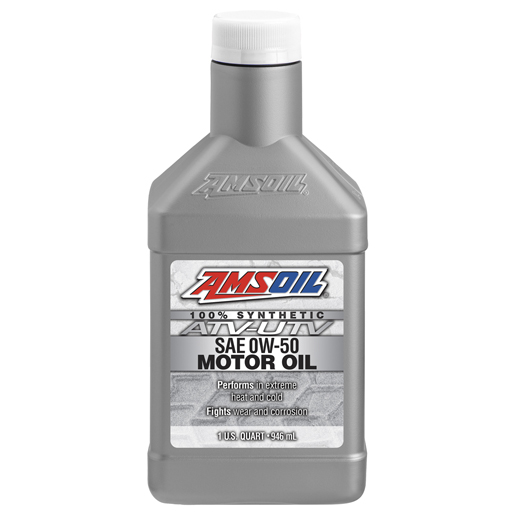
AMSOIL 0W-50 100% SYNTHETIC ATV/UTV MOTOR OIL
0W-50 synthetic that drops into a Polaris Ranger, RZR, Sportsman, or General built around PS-4 Extreme, and stays in through summer.
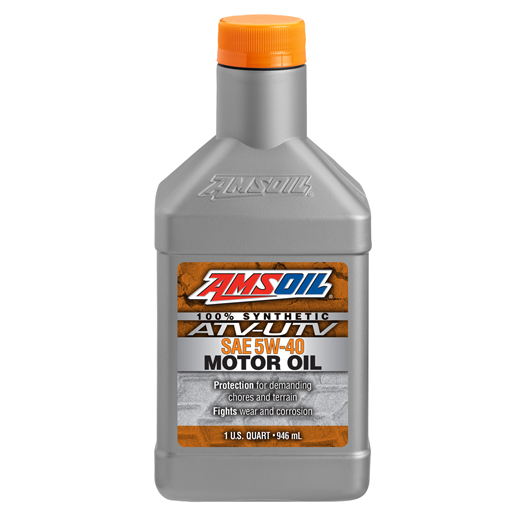
AMSOIL 5W-40 100% SYNTHETIC ATV/UTV MOTOR OIL
Wet-clutch-safe 5W-40 for Can-Am, CFMOTO, and Kawasaki machines that carry accessories and work hard in the heat, with a 0.38 mm wear scar.
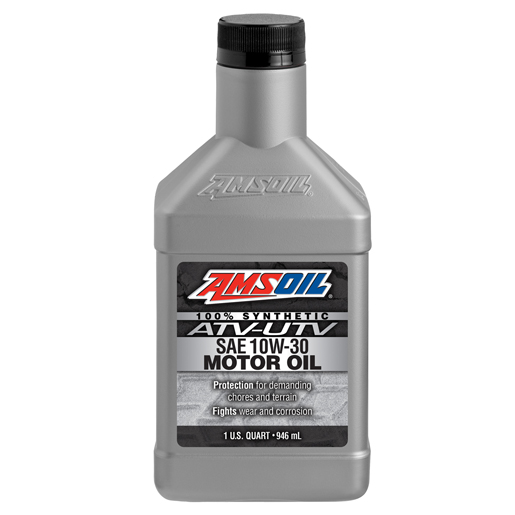
AMSOIL 10W-30 100% SYNTHETIC ATV/UTV MOTOR OIL
Purpose-built 10W-30 for Honda quads and side-by-sides, carrying API SJ, JASO MA wet-clutch performance, and the lowest evaporation loss in the range.