
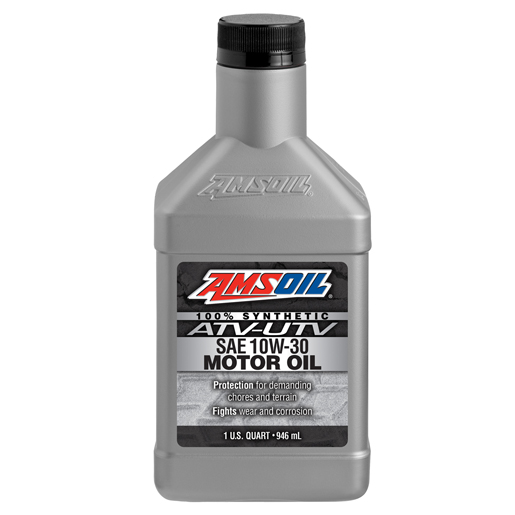
AMSOIL 10W-30 100% SYNTHETIC ATV/UTV MOTOR OIL
Product codes and package options
| Product Code | Package Size | Unit of Measure |
|---|---|---|
| AUV30QT-EA | Quart Bottle | Each |
| AUV30QT-CA | Quart Bottle | Case of 12 |
Built for Honda quads and side-by-sides, AMSOIL 10W-30 100% Synthetic ATV/UTV Motor Oil goes into machines that call for a 10W-30 with API SJ and JASO MA performance. It is the lightest grade in the AMSOIL Synthetic ATV/UTV Motor Oil range at 10.5 cSt at 100°C, and it loses the least to evaporation of the five at 3 percent weight loss. A 0.38 mm four-ball wear scar and 3.3 cP of high-shear viscosity fill in the rest of the picture for an oil that runs a thinner film on purpose. Two quart-bottle codes cover it, and your manual still sets the grade and the capacity.
Honda machines that specify 10W-30
Use it in ATVs and UTVs that require a 10W-30 motor oil, including those built by Honda. The formulation was developed specifically for Honda quads and side-by-sides as a cost-effective alternative to the factory branded bottle, which is a narrower application list than the multi-brand ones attached to the heavier grades in the same range. Honda builds across a wide displacement spread, and those machines do not all take the same grade.
Grade is only half of it. Your machine also has to specify API SJ engine oil performance and JASO MA frictional performance. A model naming a different viscosity or a higher API category falls outside this oil no matter what badge is on the fender, so let the manual for your exact model and year settle it.
API SJ and JASO MA cover different ground
API SJ describes what the oil does inside the engine, covering wear, deposits, and oxidation to the level that category defines. JASO MA describes how the oil behaves between clutch plates. The two are independent, and an oil can clear one without clearing the other. A grade marking like 10W-30 tells you neither, which is why the lines printed under it are the ones worth reading.
Wet-clutch compatibility here comes from something left out rather than something added. The formulation contains no friction modifiers and promotes smooth shifting and positive clutch engagement. Friction modifiers earn their keep in a car engine, where less friction returns fuel economy, and they are exactly the wrong ingredient where the same fluid has to let a clutch pack lock up under load.
Three percent evaporation loss
Noack volatility measures 3 percent weight loss under ASTM D5800, the lowest figure among the five grades here, which run 4.7 percent for the 10W-40 and 5W-50, 4.8 for the 5W-40, and 6.7 for the 0W-50. The test holds a sample at high temperature and weighs what leaves. What leaves is the lightest part of the oil, so a low number means less topping up between services and less thickening of what stays.
The ignition properties under ASTM D92 sit alongside it, with a flash point of 242°C (468°F) and a fire point of 264°C (507°F). Both come from heating oil in an open cup until the vapor above it lights. They describe the fluid rather than telling you how hot a running engine gets, and both sit far above normal sump temperatures.
The lightest film in the range
Kinematic viscosity is 65.7 cSt at 40°C and 10.5 cSt at 100°C under ASTM D445, with a viscosity index of 148 under ASTM D2270. Those are the lowest numbers in the range on all three counts. A lighter oil circulates with less resistance and gets into tight clearances faster, which is what an engine designed around a 30-weight is built to expect. Fitting a heavier grade to chase film thickness works against that design.
High-temperature, high-shear viscosity is 3.3 cP at 150°C under ASTM D5481. The test drives oil through a narrow clearance at speed and heat to estimate the film left in a loaded bearing, and this is the thinnest of the five grades because the grade itself is the lightest. Comparing it against a 50-weight result tells you more about the grades than about the oils.
The ASTM D4172 four-ball wear test spins one ball against three clamped in an oil bath at 150°C, 1,800 rpm, and 40 kg for one hour. The scar left on the fixed set measured 0.38 mm, matching the 5W-40 and coming in under the heavier grades. Take it as a bench comparison under one fixed load rather than a projection of engine life.
Cold flow, hard work, and packaging
Pour point is -42°C (-44°F) under ASTM D97, the shallowest of the five grades, which follows from the 10W winter rating. Pour point is a laboratory flow property recorded as the last temperature at which a chilled sample still moves, and it does not translate into a guaranteed cranking temperature. The oil stays fluid in subzero temperatures to keep startup protection available.
Severe-service formulation and synthetic technology protect hot, high-revving engines against wear and hold reserve protection against heat for heavily loaded engines. Advanced synthetic chemistry resists oxidation and protects against extreme heat to help prevent sludge and varnish, and the oil aids in cooling shrouded engines. Utility work loads an engine at low travel speed, which is exactly where that reserve earns its keep.
AUV30QT-EA is the individual quart bottle and AUV30QT-CA the case of twelve quarts. Package size is not a capacity guide, since sump capacities differ across the Honda machines on the list, so check the fill quantity in your manual. A top-up from another bottle is survivable, because the oil is compatible with synthetic and conventional grades, but it costs service life, performance benefit, and any extended drain support. Recycle used oil and the empty bottle.
Verified specifications
| Property | Value | Test Method |
|---|---|---|
| Kinematic Viscosity @ 100°C, cSt | 10.5 | ASTM D445 |
| Kinematic Viscosity @ 40°C, cSt | 65.7 | ASTM D445 |
| Viscosity Index | 148 | ASTM D2270 |
| Flash Point, °C (°F) | 242 (468) | ASTM D92 |
| Fire Point, °C (°F) | 264 (507) | ASTM D92 |
| Pour Point, °C (°F) | -42 (-44) | ASTM D97 |
| Noack Volatility, % weight loss (g/100g) | 3 | ASTM D5800 |
| Four-Ball Wear Test, mm (150°C, 1800 rpm, 40 kg, 1 hr) | 0.38 | ASTM D4172 |
| HT/HS Viscosity @ 150°C, cP | 3.3 | ASTM D5481 |
Questions about AMSOIL 10W-30 100% SYNTHETIC ATV/UTV MOTOR OIL
Honda ATVs and UTVs that require a 10W-30 motor oil and specify API SJ with JASO MA performance. A brand match on its own is not enough, because Honda covers a wide displacement spread and the grade requirement changes across models and model years. The owner's manual for your exact machine confirms it.
Noack volatility gets measured under ASTM D5800 by heating a sample and weighing what evaporates, and 3 percent is the lowest result among the five grades in this range. Fewer light fractions leaving the sump shows up as less oil consumed between services and less thickening of the oil left behind.
API SJ sets the engine oil performance category, addressing wear, deposits, and oxidation. JASO MA covers frictional performance where a wet clutch runs in the same oil as the engine and transmission. They are separate requirements, and a machine with a shared sump usually names both alongside the viscosity grade it needs.
The grade comes from the machine, not from the load. This oil measures 3.3 cP of high-temperature, high-shear viscosity, the lightest of the five grades in the range, because a 10W-30 is what certain engines are built around. Heavier grades exist in the same range for machines that specify them, and swapping one for another ignores the design.
Both carry JASO MA and share a 242°C flash point, but the 10W-30 is rated API SJ against API SL and measures 10.5 cSt at 100°C against 14.1 cSt. Its four-ball scar is 0.38 mm against 0.57 mm and its evaporation loss 3 percent against 4.7. The grade your engine requires decides between them.
Keep service timing on the original equipment manufacturer oil-change recommendation. A synthetic base oil does not extend a factory interval on its own, and extended drain intervals are not supported where oils have been mixed. Aftermarket oil additives are not recommended either, so the oil goes in as supplied and comes out on the schedule your manual sets.
Related products in this category
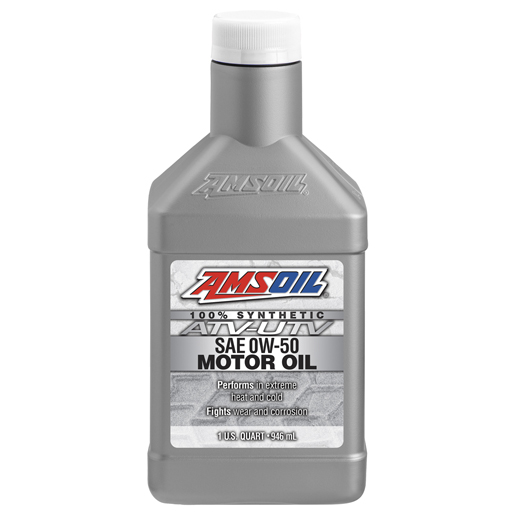
AMSOIL 0W-50 100% SYNTHETIC ATV/UTV MOTOR OIL
0W-50 synthetic that drops into a Polaris Ranger, RZR, Sportsman, or General built around PS-4 Extreme, and stays in through summer.
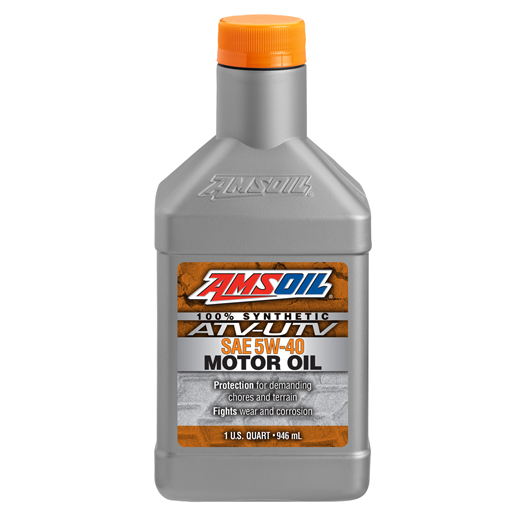
AMSOIL 5W-40 100% SYNTHETIC ATV/UTV MOTOR OIL
Wet-clutch-safe 5W-40 for Can-Am, CFMOTO, and Kawasaki machines that carry accessories and work hard in the heat, with a 0.38 mm wear scar.
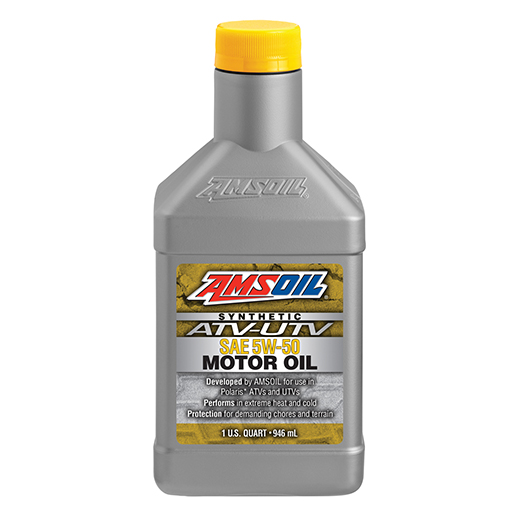
AMSOIL 5W-50 100% SYNTHETIC ATV/UTV MOTOR OIL
The heaviest grade in the ATV/UTV range at 20.1 cSt, built for Polaris machines that call for a 5W-50 with API SL and JASO MA.