
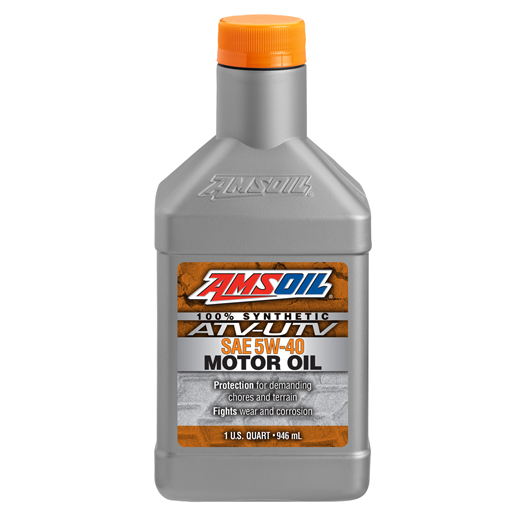
AMSOIL 5W-40 100% SYNTHETIC ATV/UTV MOTOR OIL
Product codes and package options
| Product Code | Package Size | Unit of Measure |
|---|---|---|
| AUV54QT-EA | Quart Bottle | Each |
| AUV54QT-CA | Quart Bottle | Case of 12 |
Check three things before you buy a 5W-40: the grade, API SN, and JASO MA or MA2. AMSOIL 5W-40 100% Synthetic ATV/UTV Motor Oil answers all three, and it is the only grade in the AMSOIL Synthetic ATV/UTV Motor Oil range carrying that pair of marks. Can-Am, CFMOTO, and Kawasaki machines that require 5W-40 are the published applications. The measured numbers behind it include a 0.38 mm four-ball wear scar, 4.3 cP of high-shear viscosity at 150°C, 4.8 percent evaporation loss, and a -46°C pour point. No friction modifiers go in, which is what keeps a wet clutch gripping.
Can-Am, CFMOTO, and Kawasaki machines that take 5W-40
Run it in ATVs and UTVs that require a 5W-40 motor oil, including machines built by Can-Am, CFMOTO, and Kawasaki. Three requirements have to line up at once: the 5W-40 grade, API SN engine oil performance, and JASO MA or MA2 frictional performance. Two out of three is not a match, and the brand on the fender decides none of them.
The formulation was built for Can-Am quads and side-by-sides as a cost-effective alternative to the factory branded bottle. Model year and engine layout still swing widely inside one Can-Am family, so let the manual for your exact machine name the grade. Warranty Secure coverage keeps your factory warranty intact where the oil goes into a listed application.
Reading API SN and JASO MA/MA2 off the bottle
The two marks answer different questions. API SN is the engine oil performance category, covering the wear, deposit, and oxidation requirements an engine oil has to clear. JASO MA and MA2 describe frictional behavior in a powertrain where a wet clutch shares its oil with the engine and the gearbox, which is how most quads and plenty of side-by-sides are built.
Carrying both MA and MA2 means you are covered whichever of the two your machine names. A wet clutch depends on the oil between its plates to grip instead of slide, so this formulation leaves friction modifiers out entirely. Those additives cut friction usefully in a car engine and cause clutch slippage in a shared sump. Smooth shifting and positive clutch engagement follow from leaving them out.
Accessories, load, and the heat that follows
Bolt on a roof, doors, a skid plate, a winch, and a plow and the machine weighs more than it did on the showroom floor. Every pound raises the load the engine carries at a given throttle position, and riding hard on rough ground stacks more on top of that. Extra heat from severe-duty work breaks down oils built for standard service sooner, and wear follows.
Synthetic technology puts reserve protection against heat behind a heavily loaded engine, delivers reliable wear protection, and aids in cooling shrouded engines. Bodywork wrapped tight around a powersports engine limits airflow across the cases, which leaves the oil carrying more of the cooling duty than it would in an open engine bay. Advanced synthetic chemistry resists oxidation and protects against extreme heat to help prevent sludge and varnish.
Shear, wear, and evaporation numbers
Kinematic viscosity is 97.4 cSt at 40°C and 16 cSt at 100°C under ASTM D445, with an ASTM D2270 viscosity index of 177. Those come off still oil in glass tubes. High-temperature, high-shear viscosity measures something harder at 4.3 cP under ASTM D5481, taken at 150°C while the oil gets forced through a tight clearance at speed. That second figure sits between the 4.1 cP of the 10W-40 and the 5.3 cP of the 5W-50.
The ASTM D4172 four-ball wear test clamps three balls in an oil bath and spins a fourth against them at 150°C, 1,800 rpm, and 40 kg for one hour. The scar worn into the fixed set measured 0.38 mm, matching the 10W-30 in the same range and coming in well under the 0.57 mm of the 10W-40. It ranks lubricants under one controlled load rather than forecasting hours in the field.
Noack volatility is 4.8 percent weight loss under ASTM D5800, which heats a sample and weighs what boils off. Keeping the light fractions in the sump means less oil consumed between services and less thickening of what stays behind. ASTM D92 puts flash point at 228°C (442°F) and fire point at 252°C (486°F), fluid properties rather than engine limits.
Cold starts, clutch feel, and two bottle codes
Pour point is -46°C (-51°F) under ASTM D97, a laboratory flow property rather than a cranking floor. What it means in the driveway is that the oil stays fluid in subzero temperatures and provides startup protection in the window before oil pressure pushes a film back into the top end after an overnight cold soak. For deep cold, follow the seasonal viscosity guidance in your owner's manual.
Consistent clutch feel comes from friction-durability properties that hold slippage, fade, and chatter in check as the oil heats. In a shared sump the clutch plates sit in the same fluid that lubricates the crank, so how engagement feels on a long climb tracks the frictional stability of the oil as much as the hardware. Aftermarket oil additives are not recommended for use with AMSOIL Synthetic ATV/UTV Motor Oil.
AUV54QT-EA is the quart bottle and AUV54QT-CA the case of twelve. Compatibility with other synthetic and conventional motor oils covers a top-up away from home, though adding other oils shortens life expectancy, cuts the performance benefit, and drops any support for an extended drain interval. Keep service timing on the original equipment manufacturer oil-change recommendation, and recycle used oil and bottles.
Verified specifications
| Property | Value | Test Method |
|---|---|---|
| Kinematic Viscosity @ 100°C, cSt | 16 | ASTM D445 |
| Kinematic Viscosity @ 40°C, cSt | 97.4 | ASTM D445 |
| Viscosity Index | 177 | ASTM D2270 |
| Flash Point, °C (°F) | 228 (442) | ASTM D92 |
| Fire Point, °C (°F) | 252 (486) | ASTM D92 |
| Pour Point, °C (°F) | -46 (-51) | ASTM D97 |
| Noack Volatility, % weight loss | 4.8 | ASTM D5800 |
| Four-Ball Wear Test, mm (150°C, 1800 rpm, 40 kg, 1 hr) | 0.38 | ASTM D4172 |
| HT/HS Viscosity @ 150°C, cP | 4.3 | ASTM D5481 |
Questions about AMSOIL 5W-40 100% SYNTHETIC ATV/UTV MOTOR OIL
Only if your machine requires a 5W-40 motor oil with API SN and JASO MA or MA2 performance. Can-Am, CFMOTO, and Kawasaki all appear on the application list, but grade requirements change by model and model year inside each of those ranges. Check the manual for your exact machine before you order.
API SN sets the engine oil performance category, covering wear, deposits, and oxidation. JASO MA and MA2 describe how the oil behaves between wet clutch plates when the engine, gearbox, and clutch share one oil supply. An oil can pass one and fail the other, which is why machines with a wet clutch name both alongside a viscosity grade.
The 5W-40 measures 16 cSt at 100°C against 14.1 cSt for the 10W-40, carries API SN rather than API SL, and adds MA2 to its JASO marking. Its four-ball wear scar is 0.38 mm against 0.57 mm, and its pour point reaches -46°C against -40°C. The grade your machine requires still decides between them.
They change how hard the machine works, not the grade it takes. Roofs, doors, skid plates, winches, and plows all add weight, and the extra heat from severe-duty operation breaks down oils built for standard service sooner. Synthetic technology holds reserve protection against heat for heavily loaded engines, but the required grade still comes out of your manual.
A 0.38 mm scar under ASTM D4172 at 150°C, 1,800 rpm, and 40 kg over one hour. The rig spins one ball against three fixed in an oil bath, then measures the flat worn onto the stationary set. A smaller scar means the film separated the loaded contacts better under that one condition, which makes it a bench comparison rather than a service life.
Yes, since the formulation is compatible with synthetic and conventional motor oils alike. You pay for it with shorter life expectancy, less of the performance benefit, and no support for an extended drain interval afterward. Aftermarket oil additives sit outside the recommendation entirely, so nothing else belongs in the fill at service time or later.
Related products in this category
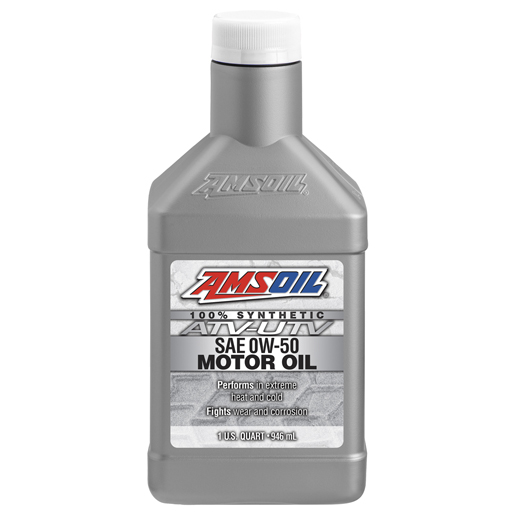
AMSOIL 0W-50 100% SYNTHETIC ATV/UTV MOTOR OIL
0W-50 synthetic that drops into a Polaris Ranger, RZR, Sportsman, or General built around PS-4 Extreme, and stays in through summer.
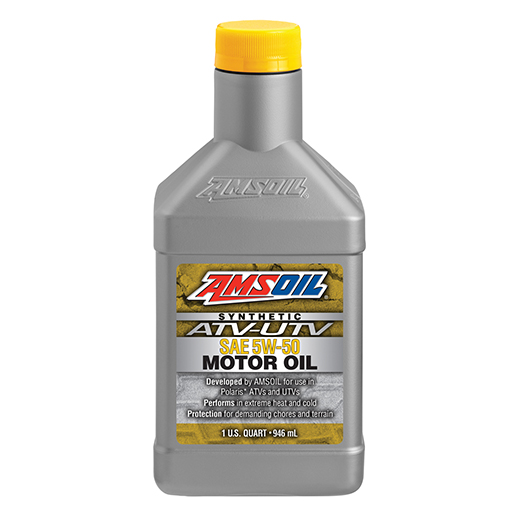
AMSOIL 5W-50 100% SYNTHETIC ATV/UTV MOTOR OIL
The heaviest grade in the ATV/UTV range at 20.1 cSt, built for Polaris machines that call for a 5W-50 with API SL and JASO MA.
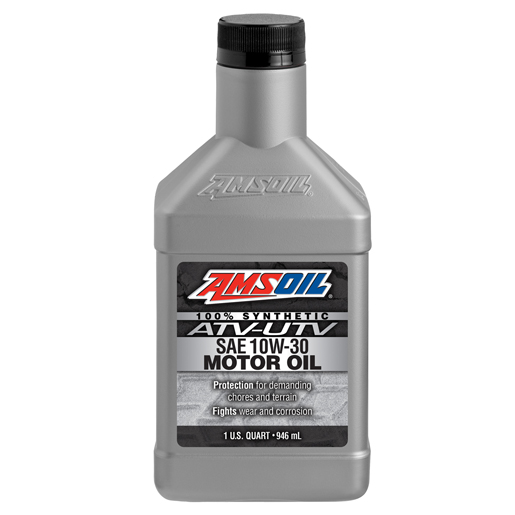
AMSOIL 10W-30 100% SYNTHETIC ATV/UTV MOTOR OIL
Purpose-built 10W-30 for Honda quads and side-by-sides, carrying API SJ, JASO MA wet-clutch performance, and the lowest evaporation loss in the range.