
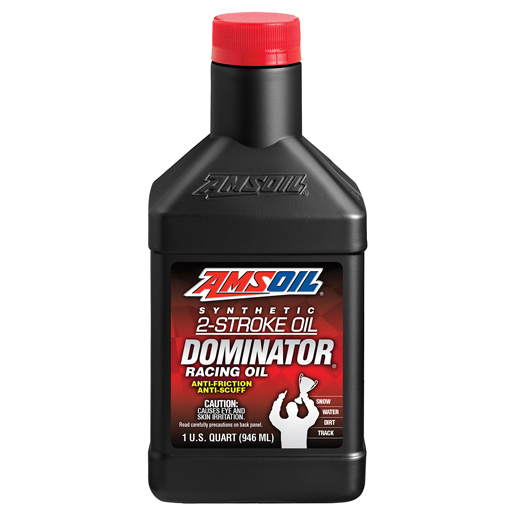
AMSOIL DOMINATOR 100% SYNTHETIC 2-STROKE RACING OIL
Product codes and package options
| Product Code | Package Size | Unit of Measure |
|---|---|---|
| TDRQT-EA | Quart Bottle | Each |
| TDRQT-CA | Quart Bottle | Case of 12 |
| TDR1G-EA | Gallon Jug | Each |
| TDR1G-CA | Gallon Jug | Case of 4 |
| TDR16-EA | 16 Gallon Keg | Each |
| TDR55-EA | 55 Gallon Drum | Each |
Mix it at 50:1 or feed it through the injection pump. AMSOIL DOMINATOR 100% Synthetic 2-Stroke Racing Oil is an API TC oil for high-performance stock or modified two-strokes, covering air-cooled and liquid-cooled snowmobiles, personal watercraft, motorcycles, ATVs, go-carts, and outboard motors. Premix works out to 2.6 ounces of oil per U.S. gallon of gasoline. Higher-viscosity synthetic base oils carry the film load in engines that can pass 10,000 rpm, and two limits mark where coverage stops: alcohol and nitromethane fuels, and long-term outboard duty. Six package sizes run from a quart bottle up to a 55 gallon drum.
Two-strokes that call for an API TC oil
Run it in high-performance stock or modified two-stroke engines, which covers air-cooled and liquid-cooled snowmobiles, personal watercraft, motorcycles, ATVs, go-carts, and outboard motors. API TC is the performance category behind that list. A two-stroke burns its oil with the fuel charge instead of recirculating it, which is why the category exists at all. Your engine has to call for an API TC oil before this one belongs in the tank.
That list runs wide because it describes a shared requirement, not a single kind of machine. A go-cart engine and a liquid-cooled sled have almost nothing in common beyond a two-stroke cycle and a lubricant that arrives with the fuel and leaves through the exhaust. What ties them together here is racing duty, where an engine spends long stretches near peak output instead of loafing along.
Premix at 50:1 or run it through injection
Premix at 50:1, which comes to 2.6 ounces of oil per U.S. gallon of gasoline. Many racers modify the mix ratio to suit their setup, so let your class rulebook or your engine builder override the general figure. Because the oil arrives dissolved in the fuel, the ratio you pour at the can is the only control you have over how much lubricant reaches the crankcase.
The same oil serves oil-injected applications that require API TC oils. Both methods on one label does not make them interchangeable on one engine. An injection system meters oil against throttle position and engine speed, so a machine equipped with one runs straight gasoline in the tank, and a machine without one has no other way to get lubricant in. Your engine picks the method, and the oil covers either.
Film strength past 10,000 rpm
Carefully selected higher-viscosity synthetic base oils handle the heat and pressure that come with high-performance and racing work. Film strength is what protects an engine that can exceed 10,000 rpm, where every revolution gives the oil less time to re-establish itself between loaded parts. Race-proven anti-friction chemistry adds another measure of protection against piston scuffing and bearing wear.
Kinematic viscosity is 35.2 cSt at 40°C and 7.0 cSt at 100°C under ASTM D445, and relative density is 0.8708. Those numbers describe the neat oil in the bottle, before it gets diluted into fuel at 50:1 or metered by an injection pump, so they characterize the concentrate rather than the mixture that reaches the crankcase. Viscosity at the point of lubrication depends on the ratio you actually run.
Carbon, plug fouling, and the fuels that are out
Clean-burning synthetic base oils and high-temperature detergent additives handle deposit control. The target is power-robbing carbon, which causes ring sticking, exhaust port blocking, and pre-ignition. Each of those costs output before it costs parts, since a stuck ring loses its seal, a blocked exhaust port chokes scavenging, and pre-ignition puts combustion pressure against a piston still on its way up the bore.
Burning clean also helps prevent plug fouling, the everyday symptom of an oil leaving residue in the combustion chamber. The oil is good for use with exhaust power valves and protects coated and non-coated racing pistons, the two components most sensitive to how a two-stroke oil behaves. Power valves sit right in the exhaust stream where carbon binds their travel, and that is the same carbon the detergent additives are formulated to control.
Two fuel restrictions apply. The oil is not suitable for use with alcohol or nitromethane fuels, which rules it out of classes running methanol or nitro no matter how well your engine matches the rest of the list. It is good for use with high-octane racing fuels, so race gasoline stays inside the range while exotic fuel chemistry sits outside it.
Outboard limits, cold flow, and six package sizes
Outboard use carries its own limit. The oil is not suitable for long-term use in outboard motors as a TC-W3 type oil, though it works as a race oil for short-term outboard use where motors get inspected periodically. TC-W3 is the water-cooled two-stroke marine category, and the line here separates a season of general boating from a race weekend with teardowns between events.
Pour point is -54°C (-65°F) under ASTM D97. Pour point marks where a chilled sample stops moving in the laboratory rather than setting an operating floor, but a figure that low matters for a snowmobile injection tank sitting outdoors between runs, since the system has to draw oil at whatever temperature the machine starts in. Flash point is 94°C (201.2°F) and fire point 94°C (201°F) under ASTM D92.
Six package options cover it. TDRQT-EA is the quart bottle and TDRQT-CA the case of twelve, TDR1G-EA is the gallon jug with TDR1G-CA covering a case of four, and for bulk, TDR16-EA is the 16 gallon keg and TDR55-EA the 55 gallon drum. The oil is compatible with most other two-stroke oils, though keep mixing to a minimum, since fuel already blended with another oil shifts the ratio away from the one you meant to run.
Verified specifications
| Property | Value | Test Method |
|---|---|---|
| Kinematic Viscosity @ 100°C, cSt | 7.0 | ASTM D445 |
| Kinematic Viscosity @ 40°C, cSt | 35.2 | ASTM D445 |
| Viscosity Index | 166 | ASTM D2270 |
| Pour Point, °C (°F) | -54 (-65) | ASTM D97 |
| Flash Point, °C (°F) | 94 (201) | ASTM D92 |
| Fire Point, °C (°F) | 94 (201) | ASTM D92 |
Questions about AMSOIL DOMINATOR 100% SYNTHETIC 2-STROKE RACING OIL
The published premix ratio is 50:1, which equals 2.6 ounces of oil per U.S. gallon of gasoline. Many racers modify the mix ratio to suit their setup, so class rules and engine builder guidance take precedence over the general figure. Because the oil travels in the fuel, the ratio you set at the can determines how much lubricant reaches the engine.
Yes, in oil-injected applications that require API TC oils. Injection and premix are both listed, which does not make them interchangeable on a single machine. An injection system meters oil against throttle and engine speed, so a machine fitted with one runs straight gasoline in the tank while a machine without one depends entirely on premixed fuel.
No. The oil is not suitable for use with alcohol or nitromethane fuels, so classes running methanol or nitro fall outside its range no matter how well the engine matches the rest of the application list. It is good for use with high-octane racing fuels, which keeps conventional race gasoline inside the published coverage.
Not for long-term service as a TC-W3 type oil. It works as a race oil for short-term outboard use where motors are inspected periodically, which describes a competition schedule with teardowns between events rather than a season of general boating. TC-W3 is the water-cooled two-stroke marine category the long-term restriction refers to.
It is good for use with exhaust power valves and protects coated and non-coated racing pistons. Power valves sit in the exhaust stream where carbon binds their movement, and high-temperature detergent additives are formulated to control exactly that deposit, along with the ring sticking and exhaust port blocking carbon causes elsewhere in the engine.
Six. TDRQT-EA is a quart bottle and TDRQT-CA a case of twelve quarts, TDR1G-EA is a gallon jug with TDR1G-CA covering a case of four, TDR16-EA is a 16 gallon keg, and TDR55-EA is a 55 gallon drum. Larger containers suit premix users blending fuel in volume across a season, while the quart bottle matches a single injection tank fill.
Related products in this category
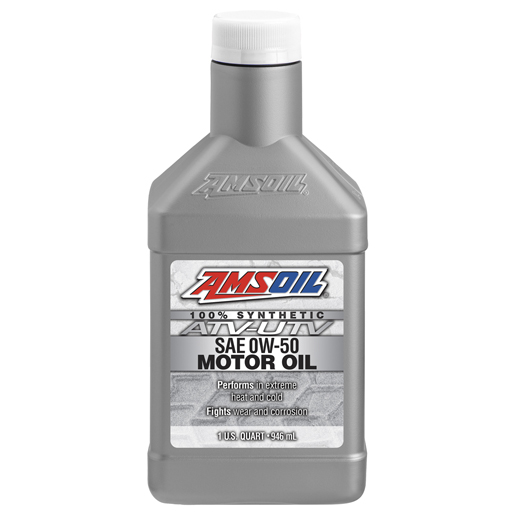
AMSOIL 0W-50 100% SYNTHETIC ATV/UTV MOTOR OIL
0W-50 synthetic that drops into a Polaris Ranger, RZR, Sportsman, or General built around PS-4 Extreme, and stays in through summer.
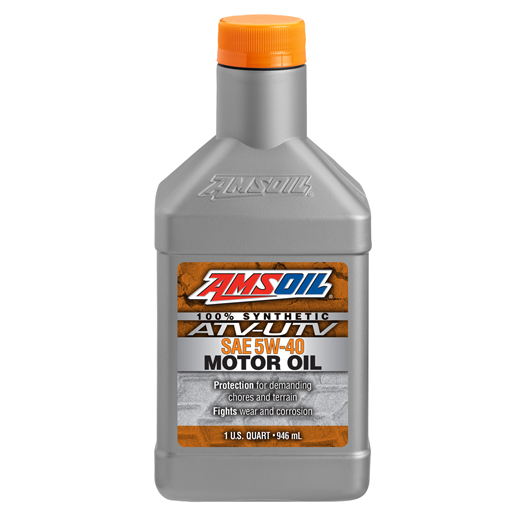
AMSOIL 5W-40 100% SYNTHETIC ATV/UTV MOTOR OIL
Wet-clutch-safe 5W-40 for Can-Am, CFMOTO, and Kawasaki machines that carry accessories and work hard in the heat, with a 0.38 mm wear scar.
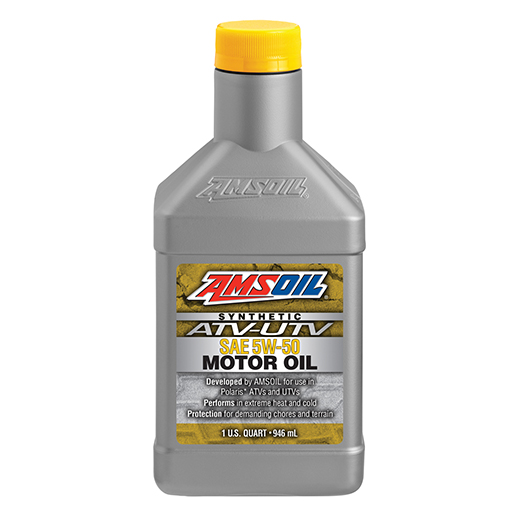
AMSOIL 5W-50 100% SYNTHETIC ATV/UTV MOTOR OIL
The heaviest grade in the ATV/UTV range at 20.1 cSt, built for Polaris machines that call for a 5W-50 with API SL and JASO MA.