
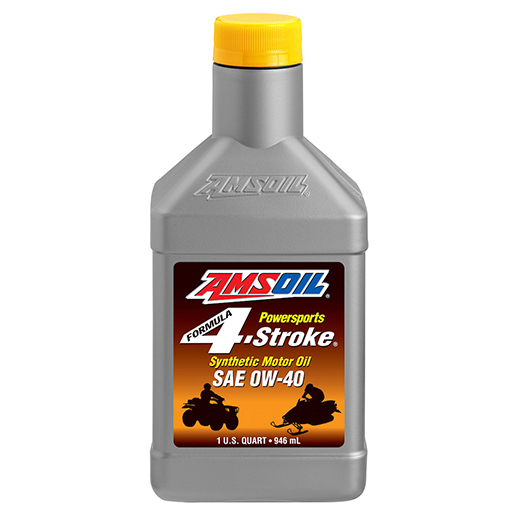
AMSOIL FORMULA 4-STROKE POWERSPORTS 0W-40 SYNTHETIC MOTOR OIL
Product codes and package options
| Product Code | Package Size | Unit of Measure |
|---|---|---|
| AFFQT-EA | Quart Bottle | Each |
| AFFQT-CA | Quart Bottle | Case of 12 |
| AFF55-EA | 55 Gallon Drum | Each |
One bottle covers six grade call-outs. AMSOIL Formula 4-Stroke Powersports 0W-40 Synthetic Motor Oil goes into four-stroke powersports engines and the transmissions that share their oil, wherever the application requires 0W-30, 0W-40, 5W-30, 5W-40, 10W-30, or 10W-40. Polaris, Honda, Yamaha, Ski-Doo, Can-Am, Suzuki, Kawasaki, and Arctic Cat all appear on the application list, alongside ATVs, UTVs, and snowmobiles. A 0W winter rating pairs with a shear-stable SAE 40 hot grade, and the label carries API SG through API SN with JASO MA/MA2 and ISO-L-EMA2. One hundred hours of dyno testing sits behind the wear claims, and anti-rust fortification covers the months a seasonal machine spends parked.
Six grade call-outs, one bottle
Use it in four-stroke engines and transmissions in powersports applications that require 0W-30, 0W-40, 5W-30, 5W-40, 10W-30, or 10W-40 oil. ATVs, UTVs, and snowmobiles all show up on the application list, along with machines built by Polaris, Honda, Yamaha, Ski-Doo, Can-Am, Suzuki, Kawasaki, and Arctic Cat. A broad viscosity range and a wax-free formulation are what let one product answer six call-outs.
That breadth is coverage, not permission to skip the manual. Your machine has to require one of the six listed grades and one of the listed specifications, and an application naming anything outside that set stays outside the product. Where your manual does name one, a single bottle can serve the quad, the side-by-side, and the sled sitting in the same garage.
The specification list on the label
The label carries API SN, SM, SL/CF, SJ, SH, and SG, plus JASO MA/MA2 and ISO-L-EMA2. API categories describe engine oil performance, and a run of them listed together means coverage of machines specified against older categories as well as newer ones. JASO MA and MA2 cover frictional behavior in a shared wet-clutch sump, and ISO-L-EMA2 comes from the international classification for four-stroke motorcycle engine oils.
Clearing a long list does not settle the fit by itself. Specification coverage and viscosity requirement are separate questions, and an oil can meet every performance mark your machine names and still be the wrong grade for it. Your manual settles the grade first, then the specification list settles whether this oil answers it. AMSOIL products are backed by a Limited Liability Warranty.
Cold cranking, then a shear-stable SAE 40 when hot
Cold-cranking simulator viscosity is 5,805 cP at -35°C under ASTM D5293. That test measures the drag the oil puts on a shaft turned inside a close-fitting cell, which is the closest laboratory analogue to a starter spinning an engine on a cold morning. Lower numbers mean less load on the starter and quicker oil movement in the first seconds of running.
Pour point is -50°C (-58°F) under ASTM D97. Together with the 0W rating it supports easy cranking, cold-weather starting, and quick post-startup protection. A wax-free formulation keeps flow available down there, since wax crystals are what thicken a conventional base oil as it chills. Pour point is still a laboratory flow property, so for deep cold, follow the seasonal guidance in your equipment manual.
Kinematic viscosity is 87.0 cSt at 40°C and 14.8 cSt at 100°C under ASTM D445, with a viscosity index of 179 under ASTM D2270. The shear-stable SAE 40 viscosity puts a thick lubricating film in place for an extra margin of protection in hard-working engines, which is how a 0W oil can be specified where a 10W-40 is named. Shear stability is what decides whether it stays a 40 weight after a season of work.
Shared sumps, gears, and wet clutches
High levels of anti-wear additives protect pistons, bearings, and gears in transmission-containing units, which describes most powersports machines, where the engine and gearbox draw from one sump. Gear teeth load a narrow sliding contact while a bearing spreads its load across a film the shaft maintains by turning, so one fill has to handle both jobs at once.
The wet-clutch-compatible formulation helps prevent clutch slippage, which keeps torque and power moving to the wheels instead of getting lost across the plates. Foam control handles a separate problem common to high-rpm engines, where churning whips air into the oil. Aerated oil carries less load and less heat, so keeping foam down promotes cooler operation and reduced wear.
Robust dispersant and detergent additives neutralize the acids and combustion byproducts powersports engines are prone to producing. Noack volatility is 7.8 percent weight loss under ASTM D5800 and flash point is 234°C (453°F) under ASTM D92. Noack measures what evaporates from a heated sample, which shows up in service as oil consumed between top-ups, while flash point is a property of the fluid rather than an operating limit for an engine.
The 100-hour dyno run, storage, and packaging
Extreme dyno testing ran 100 hours, equal to 3,421 miles or 5,028 km, and the oil delivered exceptional protection against wear and deposits across that stretch. The number describes one instrumented program rather than a drain interval, and it does not transfer to a particular machine in the field. Keep drain timing on the equipment manufacturer recommended interval, and expect no extended interval once oils have been mixed.
Anti-rust fortification protects components from rust during storage, which is the reality for seasonal equipment. A sled parked in April and a UTV that sits between hunting seasons both spend more calendar time still than running. Rust forms on internal surfaces while an engine sits rather than while it works, so part of the additive package is aimed squarely at that idle stretch.
Three codes cover the oil. AFFQT-EA is the quart bottle, AFFQT-CA is the case of twelve quarts, and AFF55-EA is the 55 gallon drum. Compatibility with other synthetic and conventional motor oils covers a top-up, though aftermarket oil additives are not recommended for use with AMSOIL synthetic motor oils. Recycle used oil and the empty bottle once the service is done.
Verified specifications
| Property | Value | Test Method |
|---|---|---|
| Kinematic Viscosity @ 100°C, cSt | 14.8 | ASTM D445 |
| Kinematic Viscosity @ 40°C, cSt | 87.0 | ASTM D445 |
| Viscosity Index | 179 | ASTM D2270 |
| CCS Viscosity @ -35°C, cP | 5805 | ASTM D5293 |
| Flash Point, °C (°F) | 234 (453) | ASTM D92 |
| Pour Point, °C (°F) | -50 (-58) | ASTM D97 |
| Noack Volatility, % weight loss (g/100g) | 7.8 | ASTM D5800 |
| Four-Ball Wear Test (40 kg, 75°C, 1200 rpm, 1 hr), Scar, mm | 0.36 | ASTM D4172B |
| Total Base Number | 9.1 | — |
Questions about AMSOIL FORMULA 4-STROKE POWERSPORTS 0W-40 SYNTHETIC MOTOR OIL
Only where the application is published as requiring 0W-30, 0W-40, 5W-30, 5W-40, 10W-30, or 10W-40 oil together with one of the listed specifications. The shear-stable SAE 40 viscosity is what makes that wider coverage possible. Your manual for the exact machine decides whether the substitution is allowed, and a grade outside that set is not covered.
API SN, SM, SL/CF, SJ, SH, and SG, plus JASO MA/MA2 and ISO-L-EMA2. The API entries cover engine oil performance across several category generations, JASO MA and MA2 address frictional behavior in wet-clutch powertrains, and ISO-L-EMA2 comes from the international classification for four-stroke motorcycle engine oils. Specification coverage is a separate question from the viscosity requirement.
Cold-cranking simulator viscosity is 5,805 cP at -35°C under ASTM D5293, and pour point is -50°C (-58°F) under ASTM D97. With the 0W rating those support easy cranking, cold-weather starting, and quick post-startup protection. Both are laboratory measurements rather than a rated minimum starting temperature, so follow the seasonal guidance in your equipment manual for deep cold.
It is formulated for transmissions as well as four-stroke powersports engines, with high levels of anti-wear additives protecting pistons, bearings, and gears in transmission-containing units. The wet-clutch-compatible formulation helps prevent clutch slippage so torque reaches the wheels, and foam control handles the aeration that churning produces in a high-rpm shared sump.
The formulation is anti-rust fortified to protect components from rust during storage, which matters for equipment that runs seasonally and then sits for months. Resistance to oxidation and oil vaporization also helps prevent carbon and varnish formation over time. Drain timing on either side of a storage period still follows the equipment manufacturer recommended interval.
One hundred hours, equal to 3,421 miles or 5,028 km, of extreme dyno testing, over which the oil delivered exceptional protection against wear and deposits. That result comes from a single instrumented program and does not establish a drain interval. Keep service timing on the equipment manufacturer recommended interval for your machine.
Related products in this category
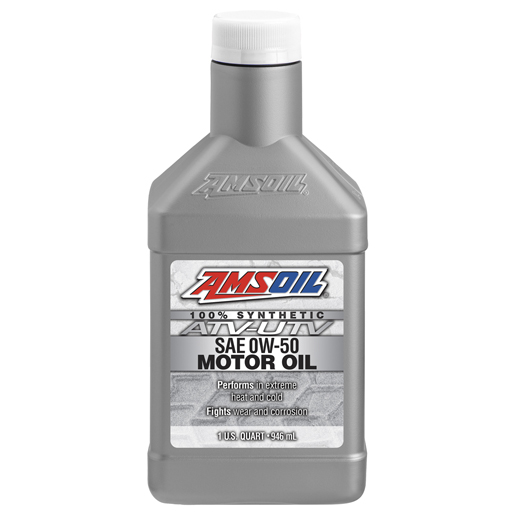
AMSOIL 0W-50 100% SYNTHETIC ATV/UTV MOTOR OIL
0W-50 synthetic that drops into a Polaris Ranger, RZR, Sportsman, or General built around PS-4 Extreme, and stays in through summer.
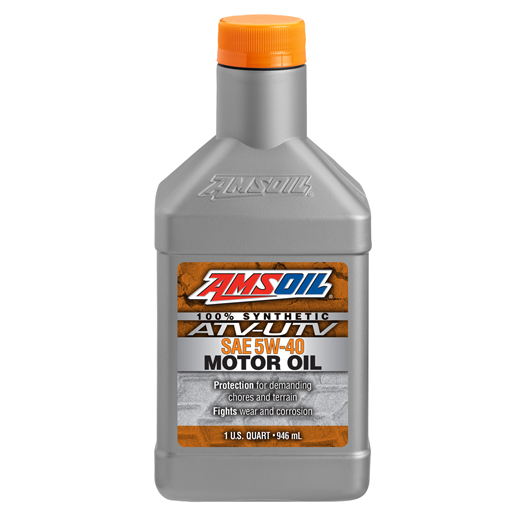
AMSOIL 5W-40 100% SYNTHETIC ATV/UTV MOTOR OIL
Wet-clutch-safe 5W-40 for Can-Am, CFMOTO, and Kawasaki machines that carry accessories and work hard in the heat, with a 0.38 mm wear scar.
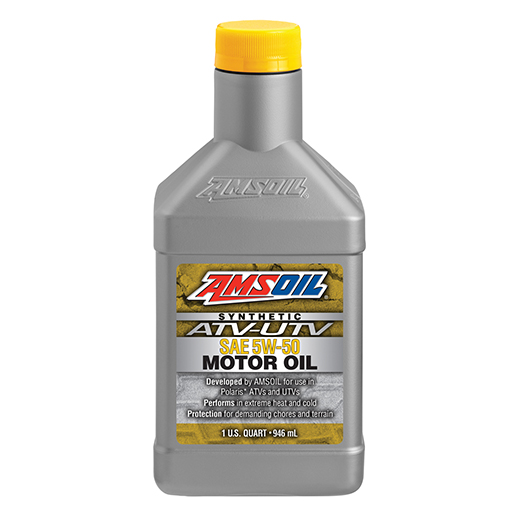
AMSOIL 5W-50 100% SYNTHETIC ATV/UTV MOTOR OIL
The heaviest grade in the ATV/UTV range at 20.1 cSt, built for Polaris machines that call for a 5W-50 with API SL and JASO MA.